Descargar libro en español
Download Executive Summary in English
Executive Summary
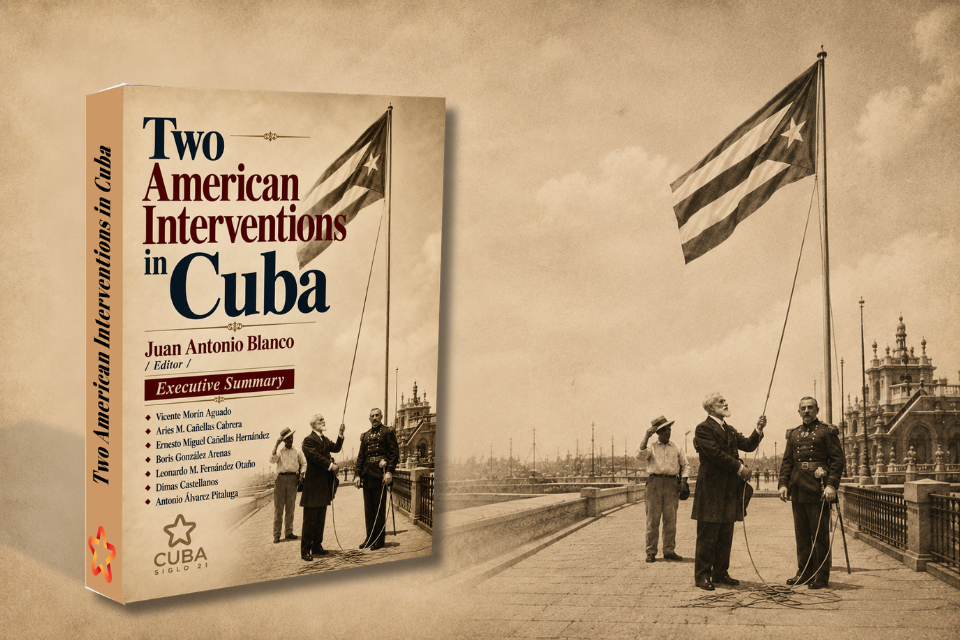
Two American Interventions in Cuba brings together seven essays that critically examine one of the most controversial chapters in national history: the United States’ intervention in the Spanish Cuban War of 1898, the military occupation that led to the birth of the Republic in 1902, and the second U.S. intervention, which began in 1906 following the political crisis that threatened the newly established constitutional order.
The book’s purpose is not to replace one dogmatic interpretation of history with another. Its starting point is precisely the opposite: to challenge an official narrative that for decades presented those events almost exclusively as episodes of imperial domination, thereby oversimplifying the complexity of the actors, circumstances, and outcomes that shaped the birth of the Cuban Republic.
The work is based on a fundamental premise: Cuba’s democratic reconstruction also requires a critical reexamination of its past. A political transition can change institutions and rulers, but it will be incomplete if the historical myths and ideological categories used for decades to legitimize totalitarianism survive intact. For this reason, historical revisionism—understood not as a denial of the facts, but as a reconsideration of their meaning considering new questions and evidence—also constitutes an exercise in intellectual freedom.
From this perspective, the volume reexamines several deeply entrenched assertions in Cuban historiography: that in 1898 Spain was practically defeated by the Liberation Army; that the U.S. intervention robbed the Cubans of an imminent military victory; that the occupation between 1899 and 1902 was fundamentally aimed at preventing true independence; that the Republic emerged as an artificial creation of Washington; and that U.S. interventions can be explained solely as manifestations of imperial expansionism.
The various authors do not offer identical answers to all these questions. This diversity is a deliberate feature of this compilation. However, their research converges on an important conclusion: the history of U.S. interventions in Cuba was considerably more complex than the binary narrative of a homogeneous Cuban nation simultaneously facing Spain and a new foreign occupant.
A War Without a Foregone Conclusion
One of the book’s main arguments challenges the notion that, in the spring of 1898, Cuban independence was militarily assured.
The Liberation Army had managed to wage a formidable war of attrition and had demonstrated that it was impossible for Spain to definitively pacify the island. But that did not mean they could achieve a decisive military victory in the short term. The independence fighters faced enormous difficulties in capturing and holding the major cities, ports, and fortifications, while Spain maintained a numerically far superior army and showed no willingness whatsoever to capitulate to the insurgents.
At the same time, Cuba in the late 19th century was far from being a homogeneous political bloc. Independence advocates, autonomists, annexationists, integrationists, and broad sectors of the population without a defined political affiliation all existed within a society deeply affected by decades of conflict. The independence revolution was decisive for the formation of the nation, but it was not without its own internal tensions, regional divisions, social and racial differences, and differing visions for the country’s future.
The U.S. intervention radically altered that balance. In just a few months, Spain suffered a defeat that put an end to four centuries of colonial sovereignty. For several of the authors, therefore, the U.S. entry into the war should not be viewed simply as the interruption of an inevitable Cuban victory, but as the factor that transformed a protracted, bloody, destructive war with an uncertain outcome into Spain’s definitive defeat.
Máximo Gómez’s own attitude illustrates these contradictions. When Captain General Ramón Blanco proposed in 1898 that Spaniards and Cubans unite against the United States, Gómez rejected the proposal. Far from viewing the U.S. intervention as an invasion against the independence for which he had fought, he saw in it the means that could hasten Spain’s defeat.
From a Devastated Country to a Republic
The book devotes special attention to an aspect often overshadowed by the debate on sovereignty and imperialism: what happened materially and institutionally in Cuba between 1899 and 1902.
The country left in the wake of the war was devastated. Agriculture and infrastructure had suffered enormous damage, unemployment was rampant, illiteracy exceeded 60 percent, and sanitary conditions were catastrophic. Of the approximately 500 sugar mills in existence, barely 217 were in working condition.
The U.S. military administration, led successively by John Brooke and Leonard Wood, undertook a comprehensive reconstruction effort. Food was distributed; public services, the police, the courts, and the postal system were reorganized; sanitation, sewer, and infrastructure projects were carried out; and a public health campaign was launched which, with the decisive contribution of a Cuban scientist, Carlos J. Finlay, made it possible to control yellow fever.
The indicators presented in the book illustrate the magnitude of the transformation. The overall mortality rate fell dramatically between 1898 and 1900, and yellow fever was eradicated from the island in 1902. In education, the number of public classrooms rose from approximately 635 to 3,550, and enrollment increased from about 38,000 students to 143,000. Free and compulsory primary education was established, the University of Havana was reorganized, and more than a thousand Cuban teachers traveled to Harvard for training.
But the most significant reconstruction was institutional.
The occupying governments incorporated numerous Cubans—including prominent figures from the independence movement—into the civil service. Municipal elections were held in 1900, and delegates to the Constituent Assembly were subsequently elected. It was Cubans, not U.S. officials, who debated and drafted the 1901 Constitution and who later elected the institutions of the new Republic.
From this perspective, the occupation appears as a contradictory period: Cuba still lacked full sovereignty, but at the same time, the institutions that would allow it to exercise that sovereignty were being built.
he Platt Amendment and the Limits of Sovereignty
The book does not shy away from the most contentious element of that transition: the Platt Amendment.
Its incorporation into the Constitution was imposed by Washington and established limited sovereignty, including the U.S. right to intervene under certain circumstances. The essays acknowledge this imposition and the tensions it caused among the Cuban framers of the Constitution.
However, the volume proposes analyzing it within the historical and strategic context of the early 20th century, rather than making it the sole explanation for the entire bilateral relationship. The Platt Amendment conditioned Cuban sovereignty, but it did not eliminate the existence of a Cuban state, representative institutions, elections, constitutional rights, or a distinct national political life.
This distinction is essential for understanding the second intervention.
1906: When the Crisis Arose Within the Republic
The second U.S. occupation was not the result of a new colonial war or an attempt to crush an independence movement. It arose from an internal Cuban political crisis.
The controversial reelection of Tomás Estrada Palma, allegations of electoral fraud, the liberals rebellion, and the inability of political forces to reach an agreement brought the country to the brink of civil war. Estrada Palma requested U.S. intervention and ultimately resigned from the presidency.
Washington then temporarily reassumed administration of Cuba.
An analysis of this episode allows the book to introduce a theme that runs throughout these essays: the distinction between occupation, intervention, stabilization, and annexation. A foreign military presence necessarily constitutes a limitation on sovereignty; however, its objectives, duration, mechanisms, and outcomes are crucial for the historical evaluation of each case.
The United States did not annex Cuba after 1898, nor did it do so after 1906. In both cases, it established temporary administrations and subsequently transferred power to Cuban governments.
The second intervention, however, exposed a weakness that would plague the Republic: relatively modern constitutional institutions coexisted with personalistic political practices, patronage, caudillismo, and difficulties in peacefully resolving conflicts over power.
1898 as a Possible Point of Reference for 21st-Century Cuba
Here, the book ceases to be merely a review of the past.
Several essays explore what lessons can be drawn from the experiences of 1898–1902 for a potential contemporary Cuban transition. The comparison does not aim to suggest that two periods separated by more than a century are equivalent. National and international circumstances are radically different. But there are problems that resurface in new forms: institutional collapse, economic deterioration, a crisis in basic services, emigration, social fragmentation, and the need to simultaneously rebuild the state, the economy, and public trust.
The experience of 1899 suggests that a successful transition requires a specific sequence of steps. Before hastily convening a definitive political process, it may be essential to reestablish minimum conditions of security, administrative functioning, essential services, legal rules, and guarantees for all stakeholders.
One of the essays pays particular attention to the use of time as a political tool. Faced with a regime that may use delay to retain power, the experience of the first occupation offers another possibility: employing a transitional period subject to verifiable objectives that, once achieved, automatically trigger the next institutional stage. The 1899 census, the municipal elections, the Constituent Assembly, the adoption of the Constitution, and finally the transfer of power in 1902 formed a sequence geared toward a specific outcome: the establishment of a Cuban government.
This reflection leads to one of the book’s most relevant contemporary messages: a transition should not be confused with either improvisation or the indefinite continuation of a provisional authority. Stabilization only acquires democratic legitimacy when it leads, through verifiable deadlines, conditions, and mechanisms, to the full restoration of sovereignty to the citizens.
Reviewing the Past to Imagine a Different Future
Two American Interventions in Cuba does not present U.S. interventions as processes free from geopolitical interests, impositions, or contradictions. Nor does it seek to diminish the fundamental role of the Cuban independence movement in nation-building. What it challenges is a teleological interpretation according to which all events must conform to a predetermined conclusion: the United States as an exclusively imperial power and Cuba as a passive victim of thwarted independence.
The picture that emerges is more complex.
Without the Cuban wars of independence, the circumstances that led to the end of Spanish rule would hardly have existed. But without the U.S. intervention of 1898, it cannot be taken for granted that Spain would have been defeated, at least in the short term. Without the subsequent occupation, it is impossible to adequately explain the speed with which a devastated country restored public services, created an extensive educational and healthcare network, organized elections, drafted a Constitution, and established a Republic. And without acknowledging the serious mistakes subsequently made by Cuban political actors themselves, it is also impossible to understand the crisis that led to the intervention of 1906.
On May 20, 1902, a fully sovereign Republic in the contemporary sense of the term was not born. It was born under the constraints of the Platt Amendment and within a deeply asymmetrical relationship with the United States. But a constitutional Cuban state was also born, with elected Cuban authorities, its own institutions, legally recognized rights, and representative mechanisms of government—something that had never existed on the island.
That acknowledgment does not require us to idealize U.S. intervention. It simply requires us to abandon the overly simplistic and binary explanations that were imposed on the nation as inescapable dogma. And therein likely lies the thesis that unifies the entire book: Cuba needs to reclaim the right to freely discuss its own history.
For decades, those in power turned certain interpretations of the past into dogmas used to legitimize the present. Revisiting them does not mean erasing Cuban patriotism or replacing one official history with another. It means restoring to historians, researchers, and citizens the freedom to ask what really happened, what alternatives existed, which decisions had positive or negative consequences, and what can be learned from them.
Because the issue raised by Two American Interventions in Cuba is not limited to 1898 or 1906. It is a question directed at the Cuba of the future: if the country once again finds itself facing a historic turning point, would it be able to learn from its past rather than become its prisoner once again?
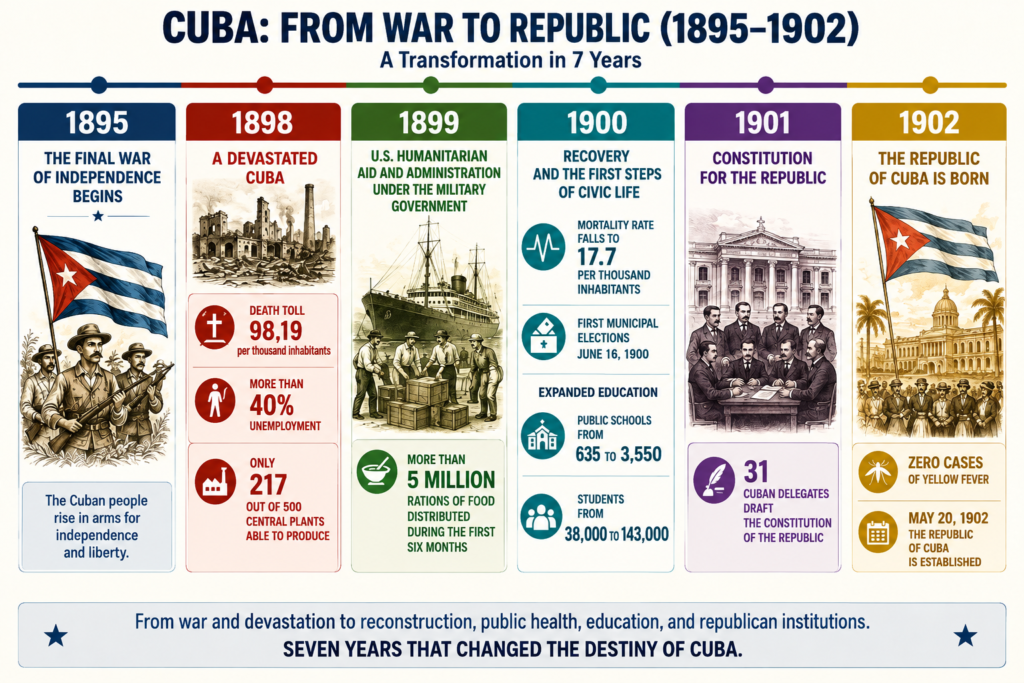
TWO INTERVENTIONS: FACTS AND FIGURES
Cuba at the End of the War: A Devastated Country
- 1,572,787 inhabitants: this was Cuba’s population as recorded by the 1899 census. Havana had approximately 240,000 inhabitants.
- More than 63.9% of the population was illiterate at the start of the U.S. occupation.
- Of approximately 500 sugar mills, only 217 were operational at the end of the war—less than half.
- Cuba had had around 3 million head of cattle in 1895, and by the end of the war, only a few remnants of that herd remained.
- More than 100 estates, 3,000 cattle ranches, 800 tobacco plantations, and 700 coffee plantations had disappeared.
- Compared to some US$150 million in capital invested before the devastation, the country had accumulated more than US$100 million in debt by the beginning of 1899.
- More than 40% of the working-age population was unemployed.
- Only about half of the public schools that existed in 1895 were still operating.
The military situation in 1898 calls into question the notion of an “imminent victory”
- The mambí liberation army is estimated by different authors around 25,000–40,000 combatants, facing 117,209 Cubans enlisted as volunteers as well as Cuban guerrillas at the service of the Spanish army, in addition to Spain’s 162,205 regular soldiers.
- In 1898, Spanish military statistics officially recorded 279,414 troops in Cuba: 162,205 belonging to the Infantry, Cavalry, Artillery, Engineers, and other corps; 30,581 in the guerrilla forces; and 86,628 in the Volunteer Corps.
- The registry subsequently compiled for the demobilization of the Mambí forces exceeded 50,000 members (the increase occurred after the U.S. declared war on Spain), but it included not only combatants but also couriers, medics, officials, and other support personnel.
- In the Eastern Campaign, Calixto García mobilized approximately 4,000 Cuban soldiers, coordinating with U.S. forces.
- In the central region, Máximo Gómez had approximately 3,000 men at his disposal, who helped hinder the movement of between 35,000 and 40,000 Spanish troops toward the East.
- The war for independence had been raging for three years without a definitive military outcome; after the United States entered the conflict, Spain was defeated in approximately three months.
From Humanitarian Emergency to Health Recovery
- In the first half of 1899 alone, more than 5 million food rations were distributed to alleviate hunger, with priority given to hospitals and charitable institutions.
- The overall mortality rate fell from19 per 1,000 inhabitants in 1898 to 17.7 per 1,000 in 1900. In other words, overall mortality dropped by approximately 82% in just two years.
- Yellow fever, one of Cuba’s greatest historical scourges, dropped to zero cases in 1902, following public health campaigns linked to the implementation of the discoveries made by Cuban physician Carlos J. Finlay.
- Sewer systems were renovated, a chlorine plant was built, the streets were disinfected twice a week, and Havana gained a waste incineration facility.
A Rapid Transformation of Education
- The number of public classrooms rose from 635 to 3,550 in about a year—more than five times the initial number.
- School enrollment rose from approximately 38,000 to 143,000 students. That represents an increase of about 276% in enrollment.
- Another source estimates that 31,000 children were enrolled in 1887; during the occupation, enrollment reached more than 172,000.
- More than 1,200 Cuban teachers were sent to Harvard for training; another source estimated 1,450 teachers.
- Education was declared free and compulsory for children aged 6 to 14.
Institutional Reconstruction and Elections
- In 1900, the first municipal elections were held under the occupation.
- Men over the age of 21 who met certain literacy or property requirements were eligible to vote; members of the Liberation Army were exempt from these requirements.
- Approximately 180,000–200,000 voters participated in the elections held between 1900 and 1901.
- The more than 53,000 discharged members of the Liberation Army thus accounted for more than a quarter of the total electorate in those elections.
- The Constituent Assembly consisted of 31 delegates.
- It was convened on July 25, 1900, its members were elected on September 15, it began its sessions on November 5, and the Constitution was signed by its 31 delegates on February 21, 1901.
- The new Supreme Court was composed of 7 justices.
- The Republic of Cuba was established on May 20, 1902, less than four years after the end of military operations against Spain.
The Cuban Presence in the United States
- There is documented evidence of at least 72 Cuban newspapers in five U.S. cities: 35 in New York, 14 in Tampa, 14 in Key West, 8 in New Orleans, and 1 in Washington.
- Most of these publications emerged during the 1880s and 1890s and were primarily linked to the independence movement, helping to inform and raise awareness among the American public and disseminate information to other newspapers about the reality of Cuba under Spanish rule.
- In April 1898, José Miguel Gómez described the United States as a nation of approximately 70 million people that was coming to the aid of the Cuban independence movement.
A Cuban Economy Already Looking Toward the United States
- In 1894, Cuba produced 1,111,000 metric tons of sugar; more than 80% of its sugar was exported to the United States.
- Following the devastation of the War of Independence, sugar production fell from 1,111,000 metric tons in 1894 to just 259,000 metric tons. This represents a decline of approximately 77% in sugar production.
Legal Measures Adopted During the First Year of Intervention—1899
- Between January and December, more than 250 orders were enacted, covering justice, administration, finance, property, municipalities, education, health, public works, and military affairs.
- June 1899 marked the peak of legislative activity, with around 40 provisions enacted in a single month.
- In just the first 11 days of January, the civil government was organized, four ministries were created, their heads were appointed, and the island’s administration was set in motion.
- The Spanish Civil and Penal Codes were initially retained, rather than repealing the entire previous legal system all at once. The practical intention was to avoid a legal vacuum while the state was being reorganized.
- The Supreme Court of Cuba was established by Civil Order No. 41, creating a supreme judicial body specific to the island.
- The judicial system was reorganized, including courts, judges, prosecutors, and procedures, and institutions inherited from the colonial administration—including the former Contentious Court—were abolished or modified.
- The Civil Registry was established and reorganized, transferring fundamental functions related to births, marriages, deaths, and civil status to the civil sphere.
- Mortgage moratoriums were enacted—including Orders 46 and 69—to address the situation of homeowners and debtors affected by the economic devastation of the war.
- Measures were taken regarding property and claims to assets, including provisions concerning abandoned properties or those affected by the conflict, as well as claims related to horses and other assets used during the war.
- Provisions were adopted to reorganize public finances and tax collection, while certain taxes inherited from the colonial system were eliminated.
- Progress was made toward fiscal decentralization of municipalities, granting them responsibilities and resources for local administration.
- Certain colonial taxes were abolished as part of measures aimed at liberalizing and revitalizing the economy.
- Academic degrees were made free of charge, eliminating burdens that hindered their recognition and the practice of the profession.
- The Official Gazette began to function as the official publication for the new government’s decrees, providing a formal mechanism for making legislation public.
- Pardons were regulated, including the continuation of measures applicable to former members of the Spanish Volunteer Corps.
- Rules governing judicial jurisdiction over crimes committed by troops were established, defining which court had jurisdiction over criminal acts attributed to military personnel.
- An administration for state lands was created, including the appointment of a State Land Inspector.
- The 1899 census was organized; it served not only a statistical purpose but also as an objective prerequisite for subsequently moving toward the convening of a constituent assembly.
What happened to the soldiers of the Liberation Army?
- At the end of the war, there were approximately 50,000 registered members who needed to reintegrate into civilian life.
- The House of Representatives even considered a private loan of approximately US$35 million to pay them, but the conditions attached to the loan led to its eventual rejection.
- President McKinley initially offered US$3 million as a grant with no future obligations.
- Immediate discharge ultimately provided approximately US$75 per soldier.
- Later, under the Republic, the so-called “payments of dues” granted a minimum of approximately US$360 in gold to the soldiers, while some generals received more than US$10,000.
The Second Intervention: 1906–1909
- The Republic had been established in 1902, and barely four years later, an electoral and political crisis led to a new intervention.
- Faced with the 1906 insurrection, the Estrada Palma administration had only about 3,000 soldiers and 600 rural guards scattered throughout the island.
- The second intervention formally began on September 29, 1906.
- It lasted until 1909, when the government was once again transferred to Cuban authorities.
- Unlike in 1898, the second intervention was not preceded by a war against a colonial power, but rather by an internal crisis within the Republic itself: allegations of fraud, political violence, armed rebellion, and the inability of the government and the opposition to reach an agreement.
- The intervention government retained the 1901 Constitution and, in 1906, established an Advisory Commission tasked with drafting much of the supplementary legislation the Constitution required to function.
- During Charles Magoon’s administration, public spending increased and practices of patronage, political bossism, and “botella” (the misuse of public salaries without performing actual work in exchange for them) became widespread, while the country had to contend with the hurricane of 1906 and the international economic crisis of 1907.
1898–2026: Two Dates Separated by 128 Years
- In 1898, Cuba emerged from three years of war, deeply devastated.
- In 2026, Cuba—67 years after the 1959 revolution—will be facing a multisystemic crisis, although it is emphasized that these are different historical contexts.
- The point of comparison is not that 1898 and 2026 are identical, but rather that both scenarios are characterized by the exhaustion of the existing model, the stubborn refusal of those in power to admit their failure and embrace change, the weakness of the organized opposition’s ability to mobilize under conditions of harsh repression, and the emergence—with the new administration in Washington—of the possibility that the U.S. decide (as in 1898) to use force to bring about a definitive turnaround in the situation.
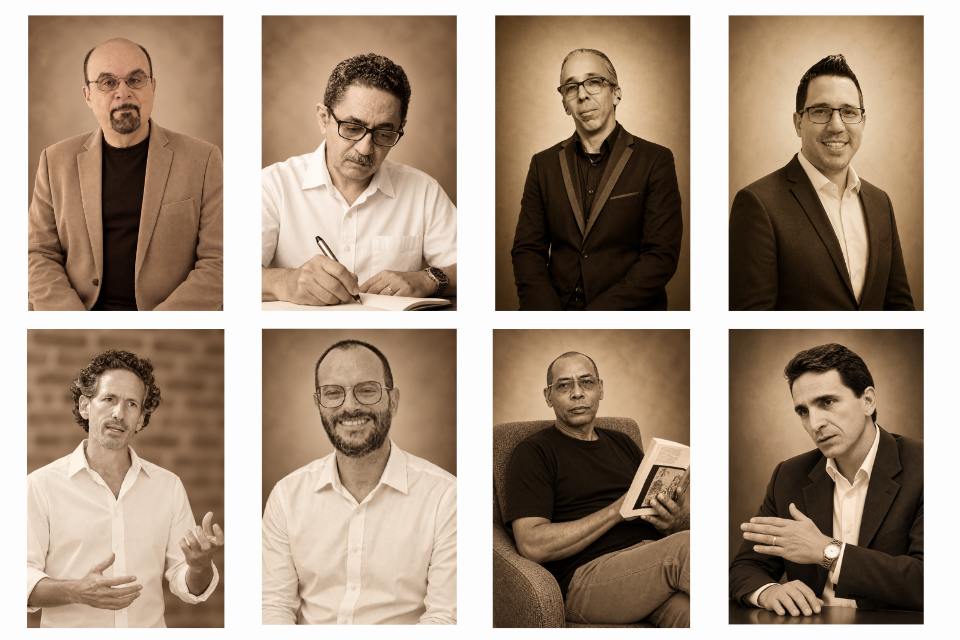
Juan Antonio Blanco / Vicente Morín Aguado / Aries M. Cañellas Cabrera / Ernesto Miguel Cañellas Hernández / Boris González Arenas / Leonardo M. Fernández Otaño / Dimas Castellanos / Antonio Álvarez Pitaluga