Descargar libro en español
Download Executive Summary in English
Ver resumen español
See Summary in English
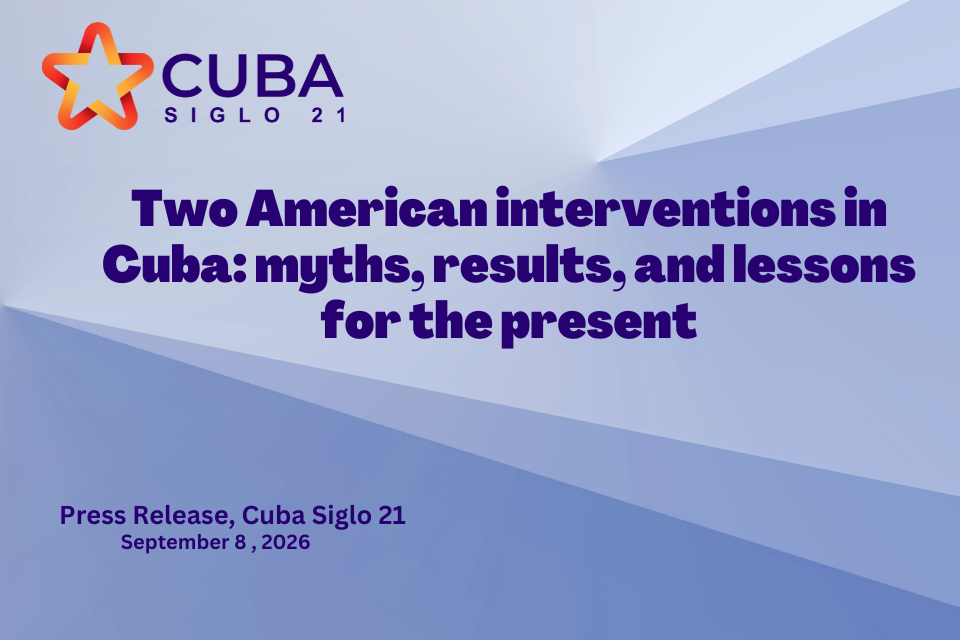
A new book on two American direct interventions in Cuba examines one of the most controversial episodes in Cuban history and argues that the experiences of reconstruction, stabilization, and the transfer of power that happened more than a century ago offer practical lessons for a new potential transition on the island
September 8, 2026— What happens when a country is in the midst of a deep crisis, its institutions lose the capacity to provide solutions, and it becomes necessary to simultaneously rebuild the economy, public services, and political legitimacy? The question seems to apply to Cuba today. However, it was also relevant—under very different historical circumstances—at the end of the War of Independence in 1898 and during the political crisis that led to the second U.S. intervention in 1906.
This link between past and present is one of the main contributions of Two American Interventions in Cuba, a volume published by Cuba Siglo 21, edited and prologued by Juan Antonio Blanco, with essays by Vicente Morín Aguado, Aries M. Cañellas Cabrera, Ernesto Miguel Cañellas Hernández, Boris González Arenas, Leonardo M. Fernández Otaño, Dimas Castellanos, and Antonio Álvarez Pitaluga.
The book proposes a reexamination of one of the most controversial chapters in national history without replacing one dogmatic interpretation with another. It does not seek to uncritically vindicate the two U.S. interventions, deny their geopolitical interests, or ignore the limitations imposed on Cuban sovereignty. It proposes something different: to reexamine the facts outside the narrative that for decades presented them exclusively as negative precedents and as a remote cause of the confrontation between Cuba and the United States.
But this reexamination is not merely an academic exercise. The events of 1898–1902 and 1906 raised problems that, in different forms, could resurface in the face of a profound transformation of contemporary Cuba: how and in what order of priorities can the task of stabilizing a country be undertaken after a major regime change: to rebuild services and institutions; to prevent a power vacuum from leading to violence or fragmentation; to organize elections and a constitutional process; and ensure that a provisional authority does not turn the transition into a new, permanent hold on power.
Reviewing History to Envision the Future
Juan Antonio Blanco argues that a political transition would be incomplete if it were not accompanied by a critical review of the historical narratives used to legitimize power. Revisionism does not mean denialism, but rather revisiting the facts, incorporating neglected perspectives, and reconsidering their meaning. His thesis has a contemporary implication: a society needs the freedom to question its past if it is to freely imagine its future.
Vicente Morín Aguado challenges a central bye of official historiography: that in 1898, the Cuban victory over Spain was practically inevitable and that the United States only intervened to snatch a victory already won by the independence fighters. His essay describes a far more uncertain scenario: Spain still held cities and ports and maintained significant material and numerical superiority, while the Cuban liberation army, despite its enormous importance, had not demonstrated the capacity to force a rapid Spanish surrender.
Morín also emphasizes that the 1899–1902 occupation was not merely a military operation. In a country devastated by war, extensive reconstruction took place in the areas of public health, education, administration, and infrastructure, alongside an institutional process that culminated in the creation of the Republic.
Aries M. Cañellas Cabrera and Ernesto Miguel Cañellas Hernández delve deeper into their critique of a predetermined view of that history. Their central idea is simple yet decisive: the outcome of the war was not predetermined. Cuban society was politically heterogeneous, with independence advocates, autonomists, annexationists, and integrationists existing within it, while some key independence advocates actively sought U.S. support.
The lesson extends beyond 1898: presenting major historical events as inevitable erases the alternatives, uncertainties, and real decisions faced by their protagonists.
Rebuilding a country is more than just changing a government
Boris González Arenas examines the intervention and occupation of 1898–1902 from a novel perspective: the possibility of interpreting part of that experience as a successful humanitarian effort. His essay draws attention to the physical condition of Cuba after years of war, forced resettlement, famine, and epidemics, and to the restoration of basic services during the U.S. administration.
His approach leads directly to a contemporary problem: replacing a government is not the same as rebuilding a country. Electricity, water, hospitals, communications, schools, security, courts, and public administration must continue to function while a new political order is being built.
The relationship between stabilization and democratization occupies a central place in Antonio Álvarez Pitaluga’s analysis. The experience that began in 1899 follows a specific sequence: restoration of minimum conditions for governance, institutional reconstruction, a census, municipal elections, a constitutional process, and the transfer of power.
From this emerges one of the book’s most important practical lessons: a transition takes time, but that time cannot become a blank check. The stages should be linked to previously established, verifiable, and auditable objectives that allow for gradual yet uninterrupted progress toward democratic normality.
1906: When Political Rules Failed
Leonardo M. Fernández Otaño examines the second U.S. intervention, which arose not from a colonial war but from the breakdown of political norms within a Republic that was barely four years old. Allegations of electoral fraud, the confrontation between the government and the opposition, the Liberal rebellion, and the inability to reach a compromise ultimately made an internal solution unfeasible.
The lesson remains relevant: a Constitution alone does not guarantee democracy if political actors cease to respect the rules and turn their adversary into an enemy who must be expelled from the system.
Dimas Castellanos explicitly extends this reflection to contemporary Cuba. His comparison between 1898 and 2026 does not present the two moments as equivalent, but it identifies problems that justify revisiting that experience: economic decline, institutional weakening, and the need to establish mechanisms capable of preventing a political rupture from leading to chaos.
His premise encapsulates much of the spirit of the book: history does not provide recipes, but it does offer experiences that allow us to recognize dangers, mistakes, and possibilities.
Finally, the analysis of time as a tool for controlling power by Antonio Alvarez Pitaluga introduces another fundamental caution. The Cuban regime has repeatedly used the argument that certain reforms must be postponed because the country is still “not ready for them” The experience of 1899 offers a contrast: the stabilization period could be linked to objective milestones—such as the census that paved the way for the constitutional process—and not simply to the will of those who were provisionally in power.
A Historical Discussion with Contemporary Implications
Two American Interventions in Cuba does not propose to replicate the events of 1898 or 1906, nor does it seek to mechanically transplant solutions conceived over a century ago into the 21st century. Nor does it present foreign intervention as a universal formula for resolving Cuba’s crises.
Its aim is to examine what worked, what failed, and what can be learned from those experiences: how to rebuild institutions after a crisis; how to combine stabilization and democratization; how to set limits on provisional authorities; how to organize a legitimate constitutional process; and how to ensure that the reconstruction of the state results in the full restoration of sovereignty to the citizens.
For this reason, the discussion that opens this volume goes beyond a mere controversy among historians.
More than a century later, Cuba once again faces fundamental questions about the viability of its institutions and the conditions necessary to build a different political order. In this context, revisiting 1898 and 1906 ceases to be merely a discussion about the past. It can become a tool for nurturing our thinking about what to do the day after the end of the current regime in Cuba.
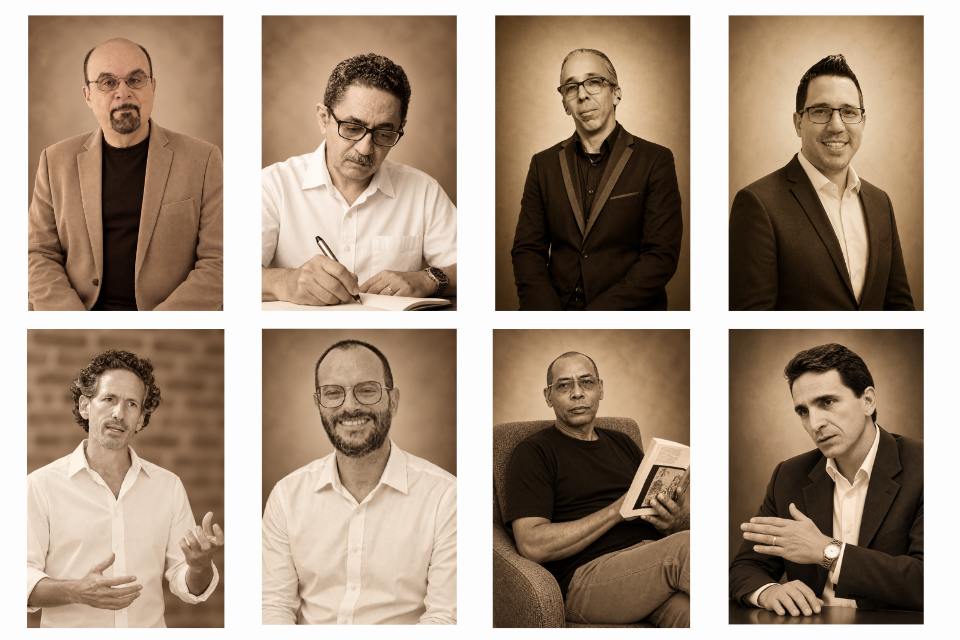
Juan Antonio Blanco / Vicente Morín Aguado / Aries M. Cañellas Cabrera / Ernesto Miguel Cañellas Hernández / Boris González Arenas / Leonardo M. Fernández Otaño / Dimas Castellanos / Antonio Álvarez Pitaluga