Descargar Dossier completo en español
Download Report in English
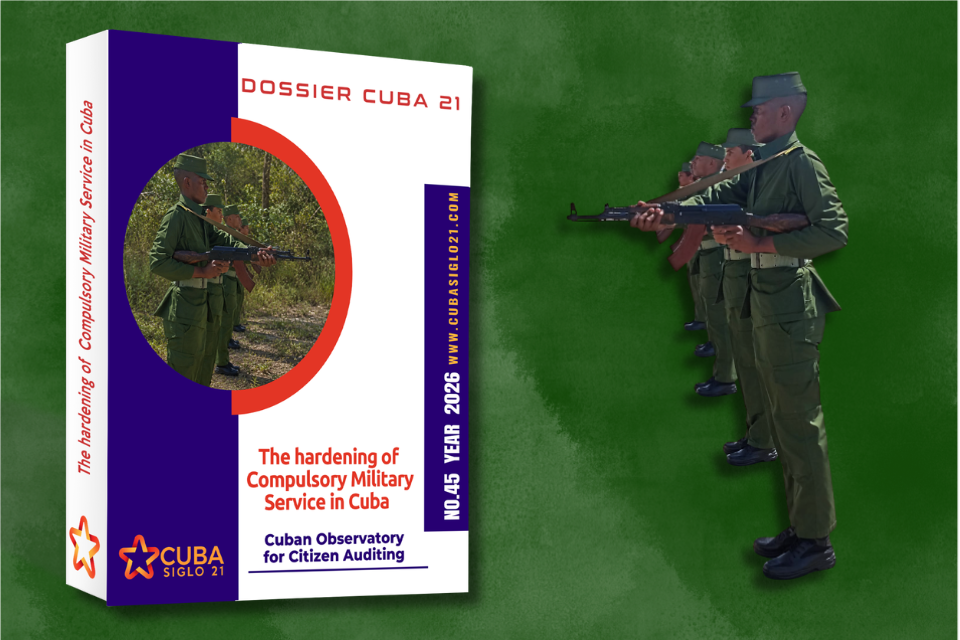
For decades, the Compulsory Military Service (SMO) has been presented by the Cuban government as a patriotic duty and a necessity for national defense. However, the evolution of this institution reveals a very different reality. While much of Latin America has eliminated, relaxed, or reduced compulsory conscription, Cuba has taken the opposite path: it has reinforced the system’s coercive nature, tightened penalties against those who attempt to avoid it, and maintained an opaque system that has been the subject of numerous allegations of abuse, negligence, and the deaths of conscripts.
Far from being an exclusively military debate, the SMO has become a reflection of the political functioning of the Cuban state. The problem is no longer merely that young people must serve in the Armed Forces, but rather the conditions under which they do so and the absence of mechanisms to protect their rights or hold anyone accountable when tragedies occur.
One of the most alarming figures documented in the report is the existence of at least 97 deaths of young people during military service between 2001 and 2026. Of these, 22 were due to suicides that occurred in 2025—the same number as the suicides recorded that same year by Israeli forces operating in a state of constant conflict. The researchers also warn that this figure represents only a documented minimum, since the Cuban government does not publish official statistics and there are numerous cases pending verification. The average age of the victims is just over 18 years.
It is particularly concerning that suicide ranks as the leading cause of recorded death, ahead of accidents, illnesses, or acts of violence. Added to this are repeated reports of young people being sent to military units despite suffering from psychological problems or illnesses incompatible with bearing arms, as well as the use of recruits in agriculture, construction, or other types of work that have little to do with military training.
Nor has the Cuban legal framework evolved toward greater protection for conscripts. On the contrary, the most recent reforms have strengthened the penalty system. Current legislation maintains compulsory military service for males starting at age 17, requires registration beginning at age 16, and expressly denies the right to conscientious objection. The new criminal and military criminal codes also impose harsher penalties on those who attempt to evade service or even injure themselves to obtain a medical discharge.
This trend contrasts with the international trend and, above all, with the trend observed in Latin America over the past three decades.
Following the end of military dictatorships and the consolidation of democratic regimes, numerous countries began to critically review compulsory conscription. Argentina abolished compulsory military service in 1994 after the death of conscript Omar Carrasco, whose murder caused a huge national outcry and precipitated rapid legal reform. Peru suspended forced conscription with the 1993 Constitution and subsequently expressly prohibited it. Ecuador eliminated compulsory service in 2008. Uruguay had abandoned it much earlier, and Chile maintains a system in which positions are first filled by volunteers and a draft is used only in exceptional cases. Even Mexico retains a form of compulsory service that, in practice, does not involve permanent confinement or the interruption of young people’s civilian lives.
The regional trend is clear: to professionalize the armed forces, reduce state coercion, and limit the use of forced conscription.
Cuba stands as an exception today.
While other countries are softening their systems, the Cuban regime maintains one of the most rigid conscription models on the continent. Not only does it retain compulsory service, but it also severely penalizes evasion, rejects any recognition of conscientious objection, and continues to expand the state’s coercive powers over young men called up for service.
This difference is even more striking when considering the island’s demographic context. Cuba is experiencing the sharpest population decline in its recent history, and the pool of young men of military age has shrunk significantly due to aging and mass emigration. Instead of making the system more flexible, various reports suggest that the authorities have relaxed the medical and psychological selection criteria to meet recruitment quotas.
The hardening of the SMO cannot be understood solely from a military perspective either. Since its creation in 1963, the institution was also conceived as a mechanism for ideological indoctrination and social discipline. Fidel Castro argued at the time that military service would serve to mold the socialist “new man” and correct behaviors considered deviant. That political function has remained in place for more than six decades through various military and paramilitary structures, including the Youth Labor Army.
The lack of transparency is another defining feature of the Cuban model. Each death is typically surrounded by contradictory official accounts, implausible investigations, and little chance for families to truly learn what happened. In numerous documented cases, family members report being pressured to remain silent, facing difficulties in accessing forensic reports, and even suffering reprisals when they demand accountability.
Other countries with mandatory military service also face problems. Israel, for example, has reported suicides among its recruits. However, the fundamental difference is that in Israel, the figures are public, the media investigates, independent oversight bodies exist, and such tragedies often lead to institutional reforms. The problem may persist, but there is public debate and mechanisms to correct failures.
In Cuba, the exact opposite is true. Opacity prevents people from understanding the true magnitude of the phenomenon and limits any possibility of citizen oversight.
More than just a military institution, Cuba’s Compulsory Military Service appears to have become an instrument of social control that has remained virtually intact for more than sixty years. In a region where the dominant trend has been to expand citizens’ freedoms vis-à-vis the state, Cuba is moving in the opposite direction. This divergence is, perhaps, one of the clearest indicators of the Cuban regime’s growing political and institutional isolation.