Descargar informe en español
Download Report in English
SUMMARY
Introduction: Historical Perspective on Intervention
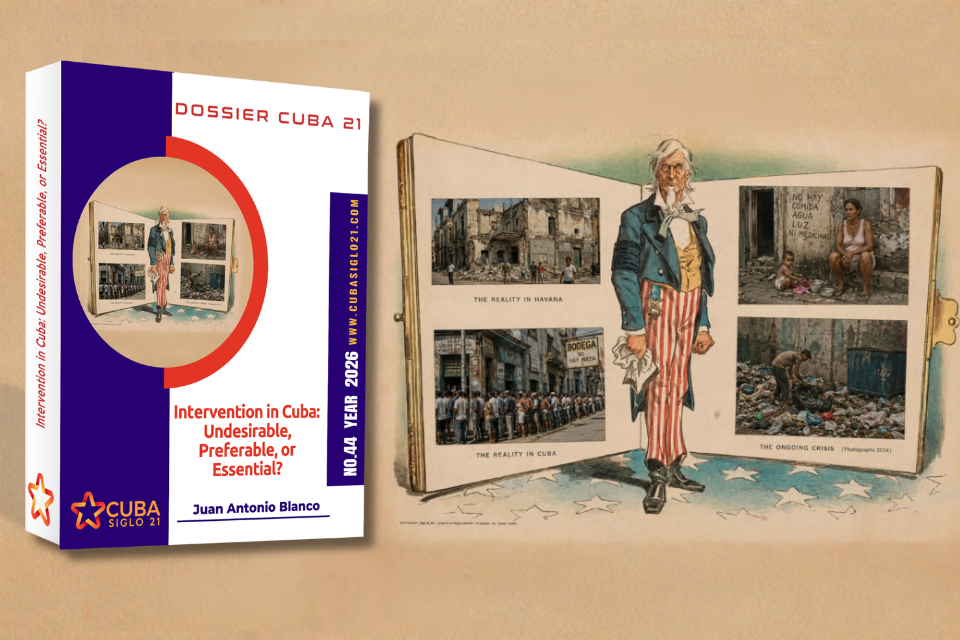
The debate over possible U.S. intervention in a process of systemic change in Cuba is situated within a historical framework that links the current situation to the crisis experienced in the late 19th century. The central focus of this reflection is a comparison of the existential crisis facing Cuba today, considered by some to be even more acute than that of 1898. From this perspective, it is argued that decisive support and / or intervention by the United States is the only variable with a real chance of leading to a free and prosperous Cuba.
Historical Parallel: The Precedent of 1898
The analysis begins with a parallel to the Cuban situation at the end of the 19th century. At that time, Cuba was undergoing a period of economic devastation, famine, epidemics, and a military conflict whose outcome was still uncertain not for all, but for many of its protagonists. The independence movement, weakened and lacking international support, had to face a colonial power that was far stronger militarily.
In that context, several independence leaders realized that victory relying solely on their own resources was at least uncertain and began actively seeking U.S. involvement. U.S. intervention was neither spontaneous nor imposed, but rather the result of a deliberate political strategy, designed by the Cuban Revolutionary Party and mambí figures seeking to save the independence cause and prevent a total national collapse.
Contemporary Cuba: A Transformed Regime and a Society in Crisis
The document argues that today’s Cuba faces a situation like that of the past. The regime that emerged in 1959 has evolved from a communist totalitarian system into what is described as a “mafia state,” controlled by a kleptocratic elite that, through the GAESA conglomerate, dominates the country’s economic and financial resources, repressing any dissent or opposition. The Cuban population, disarmed, fragmented, impoverished, and facing crises in food, energy, health, and connectivity, lacks sufficient organizational capacity to displace the established power on its own. It is concluded that relying solely on traditional forms of opposition—such as civic protests, international denunciations, or calls for dialogue—would be unlikely to bring about real change within a timeframe commensurate with the severity of the current humanitarian crisis.
Undesirable, preferable or essential?
One of the text’s fundamental arguments is that decisive U.S. intervention or support is the only variable with a significant probability of success. The author distinguishes between what is “preferable” and what is “essential”: the preferable option would be an internal, peaceful, and exclusively Cuban solution, but history and current conditions show that this is not always viable. Just as the mambises would have liked to defeat Spain on their own, they ultimately concluded that they needed foreign aid to avoid failure and cut the suffering of the population. Similarly, it is argued that today’s Cuba has reached the point where foreign aid is no longer an option but has become a strategic necessity.
Independence leaders: heroes of yesterday, “traitors” of today?
The text pays special attention to the independence leaders, posing a provocative analogy: according to the logic of the current Cuban government’s official discourse, historical figures such as Máximo Gómez and Antonio Maceo would be considered “traitors” or “annexationists.” Both, especially from late 1896 onward, considered U.S. intervention essential to ensure victory over Spain. It is recalled that Maceo conveyed favorable expectations to his troops in the event of U.S. intervention and that Gómez and Estrada Palma promoted diplomatic efforts to actively engage Washington. Contemporary official discourse tends to conceal or downplay these facts because they contradict the narrative that portrays any collaboration with the United States as unpatriotic.
The Protection of Sovereignty: From the Teller Amendment to the Helms-Burton Act
Another key argument is that the Helms-Burton Act should not be interpreted as a threat to Cuban sovereignty, but rather as its protective mechanism. A parallel is drawn between the Teller Amendment of 1898 and Chapter II of the Helms-Burton Act: just as the Teller Amendment conditioned U.S. intervention on a commitment not to annex Cuba and to transfer power to a government elected by the Cuban people, the Helms-Burton Act provides for a transitional phase followed by free elections and the restoration of sovereign control by the Cuban people. According to this interpretation, the law would act as a roadmap toward democratization and not as an instrument of annexation.
The manipulation of fear
The document devotes a section to debunking what it calls “the manipulation of fear” carried out by the Cuban government and its supporters in response to the possibility of U.S. intervention. According to the essay, official propaganda has manufactured a series of fears to discourage any popular support for that option: loss of sovereignty, annexation, indiscriminate massacres, economic plunder, or widespread national resistance. The author argues that these fears ignore both the technological evolution of modern conflicts and the political and moral erosion of the regime. Furthermore, the use of the label “annexationist” serves as a propaganda tool to delegitimize those who call for democratic changes and external alliances.
- Sovereignty: The regime claims that sovereignty would be violated, but the document argues that such sovereignty was eliminated by the state itself in 1959 when it abolished free elections; you cannot violate what does not exist.
- Massacres: In response to fears of indiscriminate bombing, it is argued that current technology allows for surgical and precise strikes against repressive forces, thereby preventing civilian massacres.
- Annexation: It is argued that annexing 11 million impoverished people would be an unbearable fiscal burden for the United States and would not have the support of the current U.S. political class.
- Historical hypocrisy: It is recalled that those who today denounce U.S. “annexationism” were in the past “pro-Soviet annexationists,” ceding territory for Soviet military bases and including a constitutional clause that tied the island to the Soviet Union.
In this context, the essay argues that, despite the fear campaigns, U.S. intervention is no longer a fringe idea among Cubans, but an increasingly “normalized” possibility. Recent polls, both inside and outside Cuba, indicate that broad sectors of society view some decisive U.S. involvement in resolving the Cuban crisis favorably. This has expanded the so-called “Overton Window,” making the debate over intervention no longer a taboo.
A Prosperous and Reinvented Cuba
The document offers a hopeful vision of Cuba’s recovery following a regime change. Unlike the more than sixty years of dependence on the USSR or Venezuela, it argues that Cuba would not require a “Marshall Plan” or an economy subsidized by foreign powers. The country’s future prosperity would rest on three pillars:
- Transnational population: A diaspora with financial and human capital ready to invest in the country.
- Entrepreneurial culture: An entrepreneurial spirit that has survived despite decades of repression.
- Geographical proximity: Proximity to the world’s largest market, allowing for integration into modern production chains.
Conclusion
In conclusion, the document argues that what would be preferable—a nonviolent and purely Cuban solution—has become impossible in the face of the ruling elite’s intransigence, making external intervention essential to prevent the nation’s physical demise. It is argued that maintaining the status quo is unviable and that the humanitarian crisis demands urgent responses. Among the possible scenarios, that of mass protests protected by U.S. coercive support appears to be the most legitimate and the one with the greatest probability of success. Although the United States has its own interests, it is suggested that these may coincide with those of the Cuban people, as occurred in the late 19th century. The final message is that the Cuban dilemma is not between sovereignty and foreign support, but between prolonging the crisis or taking calculated risks to restore freedom and rebuild the nation.