Descargar informe en español
Download Report in English
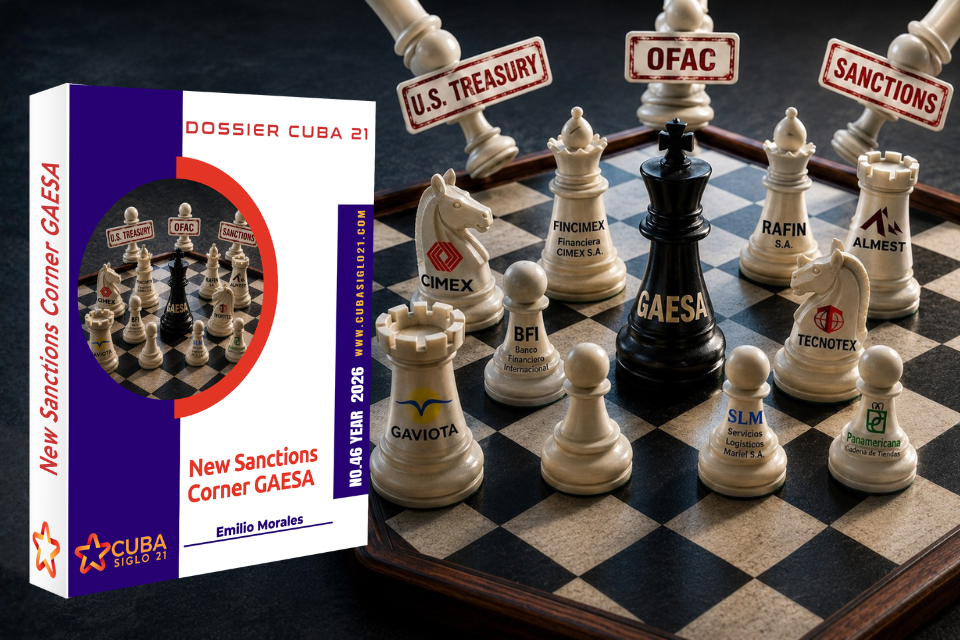
New Treasury Department Sanctions Corner GAESA
The most recent sanctions imposed by the U.S. Department of the Treasury represent a qualitative leap in the strategy of economic pressure on GAESA. According to the report, Washington is no longer merely sanctioning companies within the Castro-led oligarchic conglomerate directly, but is also targeting investors, investment funds, and foreign partners who assist in concealing or transferring its assets. The immediate goal is to prevent GAESA from circumventing sanctions by using shell companies or third countries.
The document maintains that this new strategy has led to the rapid international isolation of the Castro-led oligarchic conglomerate. Companies that for decades were strategic partners of GAESA have begun to leave the Cuban market, while potential investors are increasingly reluctant to take on the risk of being sanctioned.
The Collapse of the Tourism Model
The tourism sector stands out as the main arena where the effects of the sanctions are most evident.
For decades, tourism was the largest source of foreign currency controlled by GAESA through Gaviota and some state-owned companies. However, the withdrawal of major international chains such as Meliá, Iberostar, Barceló, and Blue Diamond constitutes, according to the author, a structural blow to the regime’s economic model.
The report particularly highlights Meliá’s departure after 36 years of operations in Cuba, presented as the end of a historic partnership that began during the Special Period.
An Industry in Free Fall
The report provides numerous indicators to illustrate the decline of Cuban tourism.
Between January and May 2026, only 359,491 tourists arrived, a 58.45% drop compared to 2025 and an 82.74% decline compared to 2019, the last year before the pandemic. In May, barely 30,883 visitors arrived, a decline of more than 90% compared to the same month in 2019. The statistical table included in the report summarizes this trend.
Hotel occupancy also reflects this collapse:
- March 2025: 23%
- March 2026: 18.9%
- May 2026: just 12.9%
The author argues that Cuba has ceased to function as a competitive tourist destination and that a large portion of current travelers are Cubans living abroad who are traveling for family reasons or to transport aid, remittances, and goods, rather than as traditional tourists.
The CEIBA Case: The New Target of Sanctions
One of the most novel aspects of the report is the analysis of the CEIBA Investments Limited case.
According to the dossier, GAESA allegedly attempted to protect some of its real estate assets by formally transferring them to CEIBA, particularly the company Inmobiliaria Monte Barreto (IMB), which owns the Miramar Trade Center.
The author argues that this transaction did not constitute a genuine separation from GAESA, but rather a mechanism to remove those assets from the scope of U.S. sanctions. Precisely for this reason, the Treasury Department ultimately imposed sanctions on CEIBA and other related entities as well.
Following these measures:
- several CEIBA executives resigned;
- the fund announced its delisting from the London Stock Exchange;
- a warning was sent to any investor attempting to act as an intermediary for GAESA.
Asset Freeze
The dossier argues that the new sanctions have an additional effect: preventing a future mass sale of state-owned hotels and properties ahead of a potential political transition.
According to the author, Washington seeks to prevent a “piñata” of corrupt privatizations through which assets controlled by GAESA could be “laundered” or transferred to private entities close to the regime before a political change.
The Internal Crisis Amplifies the Effect
The sanctions, the report argues, coincide with an unprecedented internal economic crisis that had already begun long before.
Power outages, food shortages, the deterioration of healthcare, public order, and transportation, the lack of fuel and medicines, and the collapse of public services in general had already been reducing Cuba’s appeal as a destination for investment and tourism.
Now the sanctions are cutting off access to foreign capital, while the Cuban economy itself continues to lose its ability to sustain the tourism sector.
A Scenario for Future Reconstruction
In its forward-looking section, the report argues that a potential democratic transition would open enormous opportunities for Cuban tourism.
The author argues that U.S. chains such as Marriott, Hilton, Hyatt, and Wyndham could become the new drivers of the sector thanks to their financial capacity, their international loyalty programs, and Cuba’s geographical proximity to the United States. He also foresees strong growth in commercial aviation, cruises, and foreign investment in infrastructure, energy, transportation, telecommunications, and construction.
Key Conclusions
The report summarizes four key points:
- The new sanctions have significantly weakened GAESA’s financial and operational capacity by affecting not only the conglomerate itself but also those who attempt to act as its intermediaries.
- The withdrawal of major international partners and the collapse of tourism have drastically reduced the Castro family conglomerate sources of foreign currency.
- The combination of sanctions and the domestic economic crisis is accelerating the deterioration of the Cuban economic model, but it has not been the cause of this deterioration, nor is it the reason for the popular protests since July 2021 in which—as hundreds of videos show—no one is calling for “an end to the blockade” but rather demanding “freedom.”
- The document argues that, in a scenario of democratic transition, the assets currently controlled by GAESA could become an important foundation for the country’s economic reconstruction.