Descargar reporte completo
Download report in English
Resumen en español
English Summary
A new report from Cuba Siglo 21 warns that the Cuban regime seeks to capitalize on the Republican electoral setback to influence Washington’s decisions and prevent an escalation of the conflict.
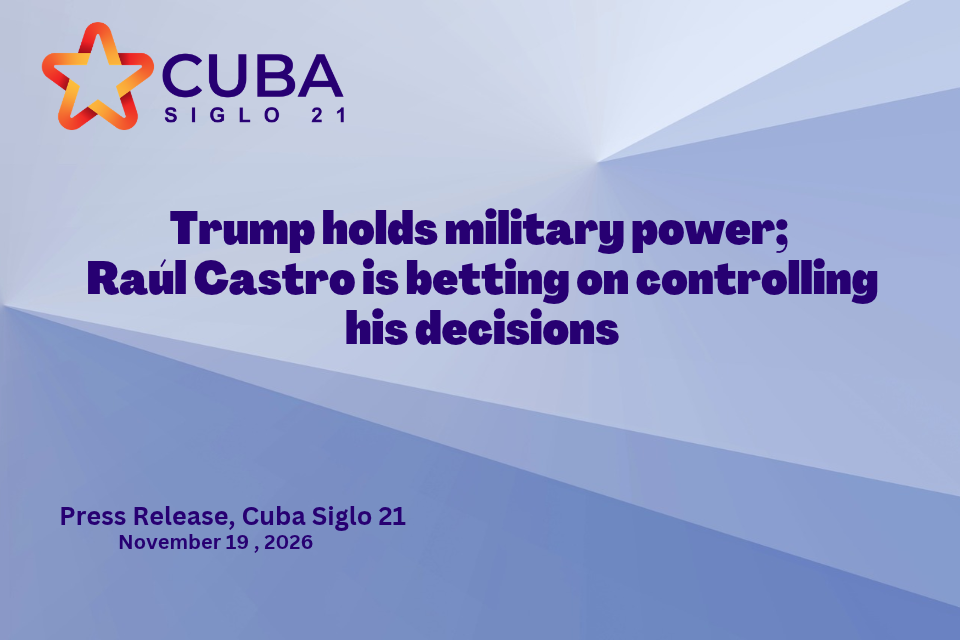
November 19, 2026. — Raúl Castro’s regime is betting on surviving the Donald Trump administration through an intense cognitive warfare strategy aimed at sowing doubt, influencing U.S. public opinion, and delaying decisions that could jeopardize his hold on power.
That is the main thesis of the new report, “Can Raúl Castro Defeat Trump? Post-Election Landscape” authored by Juan Antonio Blanco, which examines the consequences for Cuba’s future of the November 2026 U.S. congressional elections
According to the analysis, the Republican Party’s electoral defeat could hinder Trump’s domestic agenda, but it does not eliminate the president’s broad powers to act in foreign policy. Therefore, it would be a mistake to interpret the new balance of power in Congress as a guarantee of survival for the Cuban regime.
Havana, the author argues, cannot defeat the United States militarily: it suffices for it to prevent Washington from making decisive decisions that could bring about the end of its regime before January 2029.
A War Not Fought with Weapons
The dossier identifies a fundamental difference between the strategies of the two governments. While Washington has relied primarily on economic, diplomatic, and political pressure, Havana is waging what the author calls a high-intensity cognitive war.
This strategy, linked to the Soviet concept of “Reflex Control,” seeks to shape the adversary’s reasoning in order to induce decisions favorable to the interests of the party exerting influence.
In the case of Cuba, the aim would be to fuel doubts about the alleged costs of a potential confrontation and the country’s subsequent reconstruction, the risk of a civil war, the international consequences, and the legitimacy of U.S. action. The objective, according to the report, would not necessarily be to convince Washington that the regime deserves to survive, but rather to make any alternative to ending its rule seem too risky or costly.
The author draws on the experience of Vietnam to illustrate how a militarily inferior adversary can prevail politically when it succeeds in eroding its opponent’s resolve.
The report also warns against underestimating Cuban intelligence services, whose track record includes successful operations to infiltrate and influence U.S. institutions.
Is time Raúl Castro’s main ally?
The report argues that, ironically, every new pressure tactic that fails to bring about a decisive change may reinforce the perception among Cuban leaders that Washington is unwilling to go any further.
Hence, delaying the United States’ decision-making on radical measures has become a strategic tactic for Havana. The regime is reportedly banking on the fact that U.S. political divisions, isolationist tendencies, and the White House’s other international priorities will eventually push Cuba down the presidential agenda.
However, the author believes that this calculation could prove to be mistaken. A Trump weakened by Congress on domestic issues or bogged down in another international crisis might attempt to compensate for his difficulties with indisputable foreign policy achievements in Cuba that would positively define his legacy.
Crisis in the Internal Control of National Perceptions
The dossier notes that within Cuba, the strategy of controlling perceptions—which is also exercised internally against the population—has suffered significant setbacks.
The deterioration of living conditions, citizen protests, and the growing exposure of GAESA’s economic power have contributed, according to the author, to eroding the regime’s legitimacy and revealing its transformation into what he characterizes as a mafia-totalitarian state.
However, Blanco warns that no matter how deep it may be, the social discontent of an unarmed, starving, and disconnected people does not in and of itself guarantee a democratic transition in the face of a repressive apparatus that retains a monopoly on force and does not hesitate to use it.
The report also warns of the danger of a “fraudulent transition”: a fake negotiated exit that introduces changes aimed at preserving the political and economic control of the Castro family and its power elite.
Who will win the battle over Washington’s decisions?
For the author, the next two years will be decisive. The outcome will depend on Trump’s political will, isolationist pressures within the United States, and the Cuban regime’s ability to influence decision-makers.
The dossier’s central conclusion is that the standoff between Washington and Havana will not be decided solely by U.S. economic or military superiority, but also by each side’s ability to impose its own interpretation of the risks and opportunities of a kinetic confrontation
Raúl Castro cannot win a war against Trump. His strategy is to ensure that Trump completes his term without resorting to the use of force to end the Castros’ rule, something the author considers possible but highly unlikely.
The dossier emphasizes that the essence of this conflict is not between Cuba and the U.S. The core and root of the conflict, the author says, lies between the Cuban people and a totalitarian regime that has denied them, for nearly seven decades, their right to freely exercise the self-determination and national sovereignty recognized by international law. If the U.S. decides to use force to bring an end to that regime, it would be restoring—not violating—the right to self-determination and national sovereignty that international law recognizes for Cubans.