Descargar informe completo en español
Download report in English
The United States’ opening up of fuel sales to Cuba’s private sector has created a new scenario in which GAESA is attempting to preserve its control over the business through MSMEs and intermediaries, while Washington accepts the challenge and increases its capacity to oversee the island’s energy supply.
The loss of Venezuelan oil and the tightening of U.S. sanctions have presented GAESA with one of its greatest financial and strategic challenges. The military conglomerate that controls Cuba’s main foreign exchange channels is now attempting to maneuver to take advantage of the U.S. authorization to sell fuel to micro, small, and medium-sized enterprises (MSMEs). GAESA is now seeking, through a network of MSMEs and intermediaries “authorized” by it, to maintain its stake in a business on which a large part of the economy and the regime’s repressive apparatus depends.
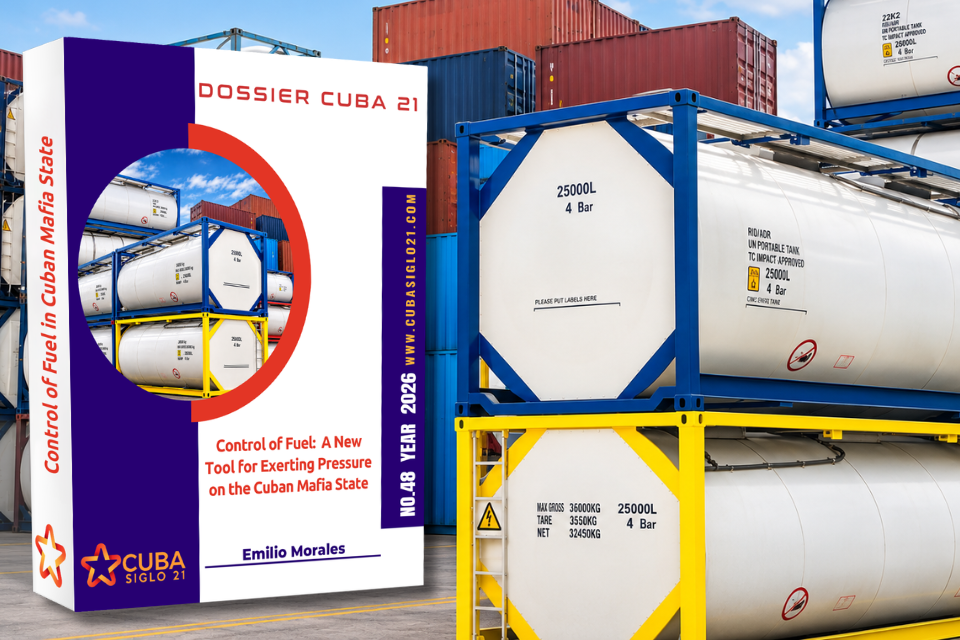
This is the central thesis of the report “Control of Fuel: A New Tool for Exerting Pressure on the Cuban Mafia State” which examines who is actually involved in these operations, how the money flows, and to what extent Cuban private companies can act independently of GAESA.
From Venezuelan Oil to U.S. Fuel
The capture of Nicolás Maduro on January 3, 2026, meant the loss of the Cuban regime’s main source of subsidized oil. The blow was not limited to energy: it also affected a major source of funding for GAESA.
According to estimates cited in the investigation, between 40% and 50% of the oil received from Venezuela was resold to third parties, primarily in Asian markets. Between 2010 and 2025, these operations reportedly generated approximately $30 billion for the military conglomerate.
In response to the Cuban energy crisis, the U.S. Department of Commerce updated its regulations to allow exports and reexports of fuel to eligible Cuban private entities and individual consumers under the “Support for the Cuban People” exception.
The measure sought to facilitate the supply of independent economic activities and essential community services, while limiting benefits to sanctioned military or state entities. However, the experiment also raised a fundamental question: Who really controls U.S. fuel imports to Cuba?
MSMEs: Independent Entrepreneurs or GAESA Intermediaries?
Although these imports are formally presented as private-sector operations, the investigation maintains that business participation is conditioned by a system of authorizations, intermediaries, and state-controlled logistical structures.
Of the nearly 390 MSMEs initially invited to participate in this market, about 42 obtained authorization in the early phases, according to data collected in the dossier.
An investigation by ADN Cuba, cited in the study, also identified 21 fuel suppliers to CIMEX, including at least 16 Cuban MSMEs. The documents revealed transactions such as the sale of 23,000 liters of gasoline for approximately $53,000, invoiced by KRV Partes y Piezas to a service station in the Oro Negro chain.
The existence of these transactions does not necessarily mean that the participating companies control the business. On the contrary, an analysis of how it operates reveals that the main assets and financial mechanisms remain in the hands of GAESA.
The real business lies in controlling the dollars
One of the dossier’s main contributions is the reconstruction of the financial circuit through which fuel is sold in Cuba.
The MSMEs do not own the gas stations: they must lease them from Inmobiliaria CIMEX, an entity linked to GAESA. Consumers, for their part, use the Clásica and Clásica Empresarial cards, issued by FINCIMEX, to purchase fuel.
The revenue collected through these cards ends up deposited in the Banco Financiero Internacional (BFI), which is also controlled by GAESA.
In this way, the military conglomerate maintains control over the key components of the business: storage facilities, gas stations, logistics infrastructure, payment methods, and bank accounts.
The decisive issue is not merely who imports the fuel, but who controls the money generated by its sale.
The dossier maintains that GAESA accounts for more than 95% of commercial and business transactions conducted in foreign currency, which allows it to wield greater financial power than the state’s own economic institutions.
A business beyond the reach of most MSMEs
The analysis of import costs is another central element of the investigation.
The fuel is transported in isotanks with a capacity of approximately 23,000 to 25,000 liters. In addition to the cost of the product itself, one must factor in the costs of the tank, maritime transport, insurance, documentation, port handling, import duties, and domestic distribution.
According to the study’s calculations, importing a 25,000-liter isotank for the first time can cost approximately $90,487 for gasoline and $134,262 for diesel, including the purchase of the container.
To begin operations with ten isotanks, a company would need to spend between $500,000 and $1.4 million, depending on the fuel and commercial terms.
Furthermore, these operations require cash payments and do not have access to standard financing mechanisms.
The sheer size of the market reinforces doubts about the ability of independent MSMEs to sustain it. Between January and August 2026, U.S. exports of fuel and derivatives to Cuba totaled approximately $232 million, including a monthly record of $74.9 million in August.
In the author’s view, these volumes can hardly be explained without the involvement of large-scale business and financial structures.
Washington Increases Pressure and Discovers New Routes
In parallel with the trade liberalization, the Trump administration has intensified sanctions against state-owned entities linked to the supply and marketing of fuel, including CUPET, ENETEC, and COREYDAN.
U.S. authorities reported the interception of 90 shipments destined for ENETEC, containing approximately 600,000 gallons of fuel valued at $2.8 million.
These operations demonstrate a strategy that combines financial restrictions, trade monitoring, and the identification of intermediaries to prevent authorized exports from ultimately benefiting sanctioned entities.
The report warns that some of the fuel formally intended for the private sector may be diverted to state institutions and repressive agencies, taking advantage of the involvement of companies linked to the regime.
The New Strategic Landscape for GAESA
The main conclusion of the investigation is that Washington has gained a capacity to monitor and exert pressure on Cuba’s energy supply that it did not previously have, while GAESA has lost much of the autonomy it once enjoyed through Venezuelan oil.
The United States faces a challenge, however: restricting supplies to the repressive apparatus without further exacerbating the humanitarian crisis facing the population. For this reason, authorizing supplies to private companies, humanitarian organizations, and other eligible recipients remains an important component of its policy. This is also why—not out of ignorance—they initially showed great flexibility in recognizing “private” MSMEs as independent entities, even though they know these entities operate in collusion with GAESA.
For GAESA, the new situation poses a twofold threat: it loses revenue from the international resale of oil and risks having its networks of intermediaries and front men identified through the tracking of commercial operations.
The U.S. energy blockade not only threatens one of GAESA’s sources of financing; it also reduces its ability to exercise discretionary control over one of the resources essential to the Cuban regime’s economic and political survival.
See the full dossier: “Control of Fuel: A New Tool for Exerting Pressure on the Cuban Mafia State” [Link to the full dossier in PDF]