Descargar Informe completo en Español
Download Report in English
Ver resumen en español
See Summary in English
A new OCAC report reveals that the documented fatality rate from crime nearly doubled in one year. In the first half of 2025, there were 5.23 deaths per 100 reported crimes: in 2026, that figure rose to 10.35, representing a 97.9% increase
September 22, 2026. — Documented crime in Cuba shows a troubling trend: during the first half of 2026 —among continuous blackouts and cuts in the Internet services—fewer crimes were reported than during the same period the previous year, but even so murders, assaults, and fatalities increased significantly, according to the new Public Insecurity Report by the Cuban Observatory for Citizen Auditing (OCAC), a project sponsored by Cuba Siglo 21.
The reduction in the number of reports does not necessarily mean that crime has decreased. The report notes that prolonged power outages, difficulties with internet connectivity, and the deterioration of the island’s information ecosystem have reduced the ability of citizens and independent media to independently report criminal incidents throughout 2026. For this reason, the decrease in the number of reports sent from Cuba does not necessarily mean that crime has decreased.
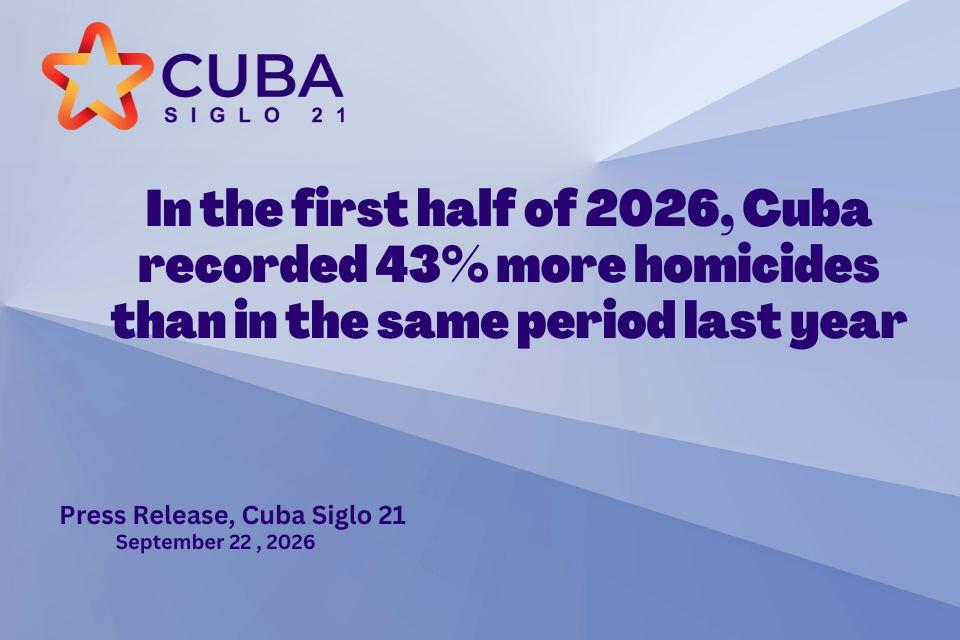
Between January and June 2026, the OCAC verified 985 crime reports, compared to 1,319 during the same period in 2025—an apparent decrease of 25.3%. However, reported homicides rose from 63 to 90, a 42.9% increase, while robberies rose from 61 to 67, a 9.8% increase.
Comparison with 2025 reveals a significant shift. That year was marked by an extraordinary, documented surge in crime: the 1,319 reports from the first half of the year—which centered on property crimes—were nearly five times the 276 recorded in 2023 and three times the 432 from 2024. In 2026, the number of reported incidents decreased, presumably due to the afore mentioned causes, but the severity of those that have come to public attention increased considerably.
Murder victims: 47.8% increase
During the first six months of 2026, 102 people died because of documented homicides, compared to 69 during the same period in 2025—an increase of 47.8%. In other words, although the OCAC documented 334 fewer crimes than a year ago, it recorded 33 more fatalities.
The indicator that best reflects this deterioration is the fatality rate. In the first half of 2025, there were 5.23 deaths per 100 reported crimes, while in 2026 the figure reached 10.35, an increase of 97.9%. In just one year, the documented fatality rate from crime nearly doubled.
Violence also accelerated within the first half of the year itself: homicides rose from 36 between January and March to 54 between April and June, a 50% increase. April, May, and June recorded 19, 17, and 18 homicides, respectively. The monthly high in 2025 had been 13.
The deterioration is particularly severe among vulnerable groups. The number of women killed rose from 24 to 37 (+54.2%); the number of elderly people killed, from six to nine (+50%); and the number of minors killed, from three to eight (+166.7%). The number of femicides documented by the Alas Tensas Gender Observatory (OGAT) rose from 16 in the first half of 2025 to 37 in the same period of 2026—more than double.
The Crime Map Is Changing
The report also identifies a territorial shift. For the first time, Matanzas ranks first nationally in homicides (18) and leads in robberies (21). Havana, which in 2025 led both categories, now records 12 homicides.
Matanzas and Granma account for 301 of the 592 robberies recorded in the country, or 50.8% of the total. Granma also ranks among the territories with the highest incidence in several categories. The drug landscape is changing as well: Holguín recorded 33 cases and Granma 27, compared to 19 in Havana. In 2025, the capital had accounted for 109 of the 198 drug-related reports.
From subsistence theft to the looting of critical infrastructure
Reported thefts decreased from 721 to 592 compared to 2025 but remain 127.7% higher than in 2024 and 397.5% higher than in 2023. In addition, the targets of these crimes are changing. While thefts of livestock and private property decreased, those targeting state property increased from 140 to 158 (+12.9%).
One of the phenomena highlighted in the new report is the looting of electrical infrastructure, particularly the theft of dielectric oil from transformers, which is subsequently sold on the black market. According to figures from the Attorney General’s Office compiled by the OCAC, between 2025 and the first half of 2026, more than 460 criminal investigations were initiated for crimes against the national power grid, with more than 300 specifically related to the theft of dielectric oil.
The report also notes a significant number of crimes committed collectively. Of the cases in which the modus operandi could be determined, 278 were perpetrated by two or more people. Among thefts, 37.7% of cases with available information were committed by groups, the highest proportion recorded by the OCAC for that category.
Likewise, the report documents incidents in which citizens have pursued or detained suspected criminals in the absence of a police response—a phenomenon the report links to the risk of an increase in forms of vigilante justice.
Cuba: More Lethal Crime
The most significant finding of this dossier: the criminal activity in Cuba that our independent sources were able to document in the first half of 2026—despite continuous and widespread power outages and internet service disruptions—shows a clear trend toward much more lethal violence than that observed a year earlier.
A comparison of the two periods reveals two distinct phases. In 2025, the main cause for alarm was the extraordinary expansion and diversification of documented crime, with a marked focus on property crimes. In 2026, the defining feature is the increase in its lethality.
The figures summarize the change: despite a 25.3% reduction in published reports, OCAC recorded 42.9% more murders, 47.8% more fatalities, 9.8% more assaults, and a lethality rate that nearly doubled in one year.
For OCAC, the decrease in the raw number of reports does not equate to a reduction in insecurity. The main finding of the new report points in a different direction: the crime that came to light in Cuba during 2026 despite the continuous blackouts and internet interruptions, was considerably more lethal than that documented a year earlier.