Descargar reporte completo
Download report in English
Resumen ejecutivo
The Republican defeat in the midterm elections opens up a new political landscape in Washington. While Donald Trump retains broad powers in foreign policy, Havana is banking on a cognitive war aimed at paralyzing his decisions in order to survive until 2029.
The Republican Party’s resounding defeat in the November 2026 congressional elections has shifted the U.S. political balance and raised questions about the future of Donald Trump’s policy toward Cuba. However, it would be a mistake to interpret that result as a guarantee of survival for the Cuban regime.
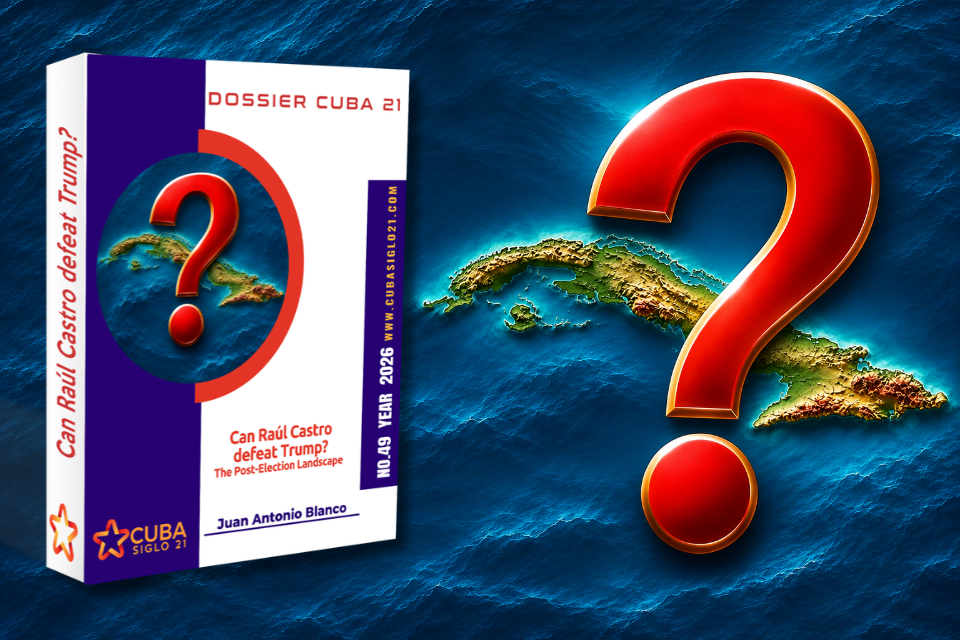
That is one of the main conclusions of the analysis “Can Raúl Castro Defeat Trump? The Post-Election Landscape”, which examines the strategies of both governments, the role of cognitive warfare, and the decisions that could determine the outcome of a protracted conflict that has lasted for nearly seven decades.
The loss of Republican control of Congress could hinder Trump’s domestic agenda, but not necessarily his foreign policy, where the president retains considerable constitutional prerogatives. He might even find in that arena an opportunity to build the historical legacy he wishes to leave upon concluding his term.
For Havana, on the other hand, the election result fuels a hope: to hold out for another two years, avoid a military confrontation, and wait for Trump to leave the White House in January 2029.
The War Havana Is Trying to Win Without Firing a Shot
The analysis argues that Washington and Havana are waging two different wars.
The United States has developed a hybrid pressure strategy, employing economic sanctions, diplomatic isolation, political actions, and demonstrations of military force. Its aim has been to persuade the Cuban ruling elite to accept a political and economic transition.
Havana, for its part, responds with an intense cognitive warfare strategy: influencing the perceptions, assumptions, and decisions of its adversaries to prevent them from taking effective measures—such as the use of force—that could genuinely jeopardize its hold on power.
The concept, known in Soviet doctrine as “Reflex Control,” consists of transmitting carefully selected information to induce the adversary to make decisions—apparently of its own volition—that are favorable to the party conducting the operation.
The dossier finds a historical precedent in Vietnam. According to its interpretation, communist forces realized that weakening U.S. political will could prove more decisive than achieving conventional military victories. The strategic battle shifted to the media, universities, political circles, and public opinion.
The Cuban regime has taken that experience to heart. Its objective is not to defeat the United States militarily—something beyond its capabilities—but rather to ensure that Washington refrains from using force over the next 24 months.
The central thesis is that Raúl Castro is convinced that he only needs to avoid a decisive confrontation to survive yet another U.S. president. The dossier concludes that while this remains within the realm of possibility, it is unlikely to happen while Donald J. Trump occupies the White House.
The Cuban Regime’s “Cognitive Missiles”
The dossier identifies various issues that form part of Havana’s influence campaigns: the danger of a civil war, the economic costs of a transition, the possible reaction of Russia, China, or Iran, the legal implications of an intervention, and the moral legitimacy of U.S. military action.
These concerns are also part of legitimate debates on international security, sovereignty, and the use of force. The author’s interpretation is that the regime seeks to exploit them to create uncertainty and delay decisions.
The analysis particularly questions the comparison of Cuba to Iraq, Libya, or Venezuela. It argues that the island lacks deep ethnic and religious divisions and autonomous armed groups that have complicated other transition processes.
It also considers the capacity of Havana’s international allies to intervene directly in its defense to be limited, given their own geopolitical difficulties.
Regarding the cost of reconstruction, the dossier maintains that Cuba possesses three exceptional advantages: its proximity to the United States; the financial and social capital of the diaspora (as well as the human capital found both within the diaspora and among citizens on the island); and, finally, the extraordinary entrepreneurial spirit of the Cuban people.
According to the dossier, an economic opening—accompanied by legal guarantees and political freedoms—could mobilize significant private investment without relying on a massive U.S. federal assistance program.
The analysis rejects the argument that U.S. military action in support of the Cuban people could be classified as a violation of their right to sovereignty and self-determination. On the contrary, the dossier asserts that such action could be interpreted as a U.S. effort aimed at restoring—rather than violating—the right of the Cuban people (the only legitimate holders of this right) to exercise self-determination and national sovereignty; a right that has been suppressed for nearly seven decades by a regime that denies them the ability to exercise it.
The threat that Washington may be underestimating
Another central argument in the dossier concerns the capacity of Cuban intelligence services to carry out infiltration, disinformation, and international influence operations.
The author cites cases such as those of Ana Belén Montes, Víctor Manuel Rocha, and the “Wasp Network” (Red Avispa)—along with revelations from former intelligence officer Florentino Aspillaga—to illustrate a long-standing pattern of penetration into U.S. institutions.
For a long time, the dossier argues, Washington underestimated the Cuban threat because it viewed the island as a secondary adversary compared to powers like Russia or China.
Havana, by contrast, has spent nearly seven decades studying a single adversary: the United States.
The dossier warns that measuring the success of U.S. policy solely by the number of sanctions, the entities affected, or the economic resources restricted can lead to a flawed perception of how the conflict is unfolding. While Washington tallies economic pressures, Havana will measure its own progress by the U.S. decisions it manages to delay, modify, or prevent.
The regime is losing the cognitive war within Cuba
Paradoxically, while the Cuban government attempts—with some degree of success—to influence international opinion, it has suffered a profound loss of credibility among its own citizens.
The collapse of public services, poverty, blackouts, and inequality have eroded the promises of well-being and social justice that, for decades, underpinned the official narrative.
The dossier highlights, in particular, the growing public awareness regarding GAESA and the transformation of the communist totalitarian system into what the author terms a “mafia-totalitarian state.”
The perception that an oligarchy controls the country’s primary economic resources—while the population faces a humanitarian crisis—has weakened the regime’s legitimacy, even among former supporters of the Revolution.
The protests of July 11, 2021—during which participants demanded “freedom” and no one raised slogans against the United States—served as a demonstration of this shift.
However, popular discontent alone does not guarantee a transition. The author identifies two essential conditions: access to the internet, free from government control, and effective international backing—including a credible threat of the potential use of force—to prevent the mass repression of peaceful demonstrations.
He also warns against the mirage of negotiated solutions in which the non-governmental side lacks any real bargaining power. Such exercises facilitate and legitimize a “fraudulent transition”—the negotiation of partial reforms designed to preserve the political monopoly and economic hegemony of the Castro family and its power elite. Without an external ally to back the pro-democracy negotiators with a credible threat of the use of force against the oppressors, the regime’s representatives will hold all the cards, ensuring their own interests prevail.
Are the conditions for a transition in place?
The dossier maintains that, over time, the United States has amassed legal, diplomatic, economic, and military instruments that would allow for more forceful decisions regarding Cuba.
Among these, it cites the Helms-Burton Act, new sanctions, hemispheric security cooperation, and the recent strengthening of both U.S. and regional military capabilities.
Nevertheless, it acknowledges that the existence of these resources does not necessarily guarantee that Trump will choose to employ all of them.
The outcome would depend on the interplay of three factors: the president’s aspiration to leave a significant historical legacy in foreign policy, the influence of isolationist currents within the Republican Party, and the effectiveness of Havana’s influence campaigns.
The author also addresses the Cuban civilian and military sectors, suggesting that the survival of their institutions—and the individuals within them—may depend on their willingness to drive a genuine transformation toward the rule of law, political and economic freedoms, and democratic alternation of power. He cites the transitions in Spain and Poland as precedents for negotiated change.
The decision that could define Trump’s foreign policy legacy
The analysis concludes that the Cuban system has already collapsed as a functional model of governance. Its crisis, the author argues, began long before Trump’s return to the presidency and stems from the internal contradictions of the current regime. While U.S. pressure may accelerate this process, it is not the root cause.
The great unknown is whether Trump will choose to escalate the confrontation—potentially even resorting to the use of force—or whether he will allow Havana to continue managing its own survival until the end of his presidential term.
In the author’s view, a democratic transition in Cuba could provide Trump with a historical legacy comparable, in its geopolitical significance, to the end of Soviet communism during the Ronald Reagan era.
The alternative would be for the Castro family to once again outlast a U.S. president, despite the country’s extreme deterioration and its limited economic and military capacity—a scenario that seems highly unlikely under President Trump.
Nevertheless, the confrontation between Raúl Castro and Donald Trump will not be determined solely by the military or economic superiority of the United States. Rather, it will be decided, first and foremost, by the perceptions held by those who make the decisions in Washington. It is for this reason that Havana seeks to keep these matters under control, aiming to prevent current pressures and threats from ultimately evolving into U.S. executive decisions to resort to the use of force to assert the right of the Cuban people to exercise self-determination and sovereignty against the Castro family and its power elite.
Havana is betting on buying time. Trump faces a decision that could define his foreign policy legacy. The author highlights the underlying tragedy: while both sides calculate their next moves, millions of Cubans remain trapped in an existential humanitarian crisis that cannot afford to wait another two years.
In its conclusions, the dossier emphasizes that the essence of this conflict does not lie between Cuba and the United States.
The core and root of the conflict, the author argues, exist between the Cuban citizens and a totalitarian regime that, for nearly seven decades, has denied them the right to freely exercise the self-determination and national sovereignty recognized under international law. Should the U.S. decide to use force to bring an end to that regime, it would be restoring—not violating—the right to self-determination and national sovereignty that the totalitarian regime has suppressed for decades, and which international law guarantees to the Cuban people.