
Descargar Informe completo en Español
Download Report in English
Key Figures
- Given the challenges of Cuba’s information ecosystem, which is affected by prolonged and continuous power and internet outages, 985 crimes were reported from the island in the first half of 2026: 25.3% fewer than the 1,319 reported in 2025.
- During this period, there were 90 homicides: a 42.9% increase compared to the 63 recorded during the same period in 2025.
- There were 102 fatalities: 33 more deaths than in 2025, when there were 69. This represents a 47.8% increase.
- 10.35 deaths per 100 reported crimes, compared to 5.23 a year earlier: the fatality rate increased by 97.9%, practically doubling.
- 8 minors killed, compared to 3 in 2025: +166.7%, the largest increase among the victim groups analyzed.
- 37 women killed, compared to 24: +54.2%. The number of elderly people killed rose from 6 to 9: +50%.
- 37 femicides documented by OGAT, compared to 16 in the first half of 2025: +131.3%.
- Violence accelerated during 2026: murders rose from 36 in the first quarter to 54 in the second, a 50% increase. April, May, and June recorded 19, 17, and 18 murders, respectively.
- 67 robberies: +9.8% compared to 2025 and +71.8% compared to 2024, despite the overall decline in the number of such crimes reported.
- 592 robberies: those reported—with fewer data sources available than in 2025—decreased by 17.9% compared to last year, but are still 127.7% higher than in 2024 and 397.5% higher than in 2023.
- 158 thefts of state property: +12.9%, while thefts of private property and livestock have decreased.
- More than 460 investigations into crimes against the National Electric Power System between 2025 and the first half of 2026; more than 300 involved the theft of dielectric oil from transformers.
- 37.7% of the thefts were committed by groups, the highest proportion recorded by the OCAC for this category.
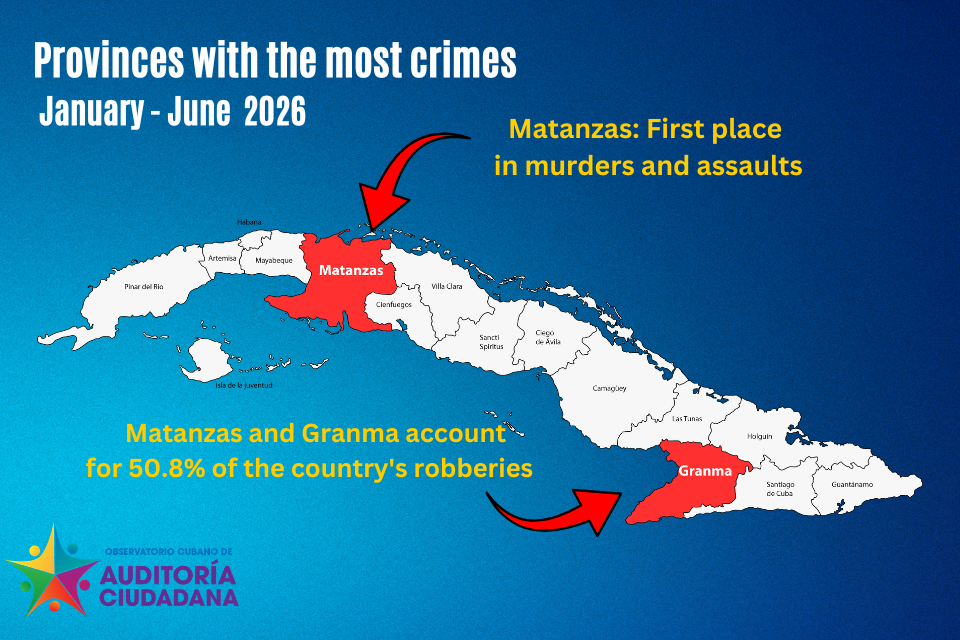
- Matanzas has emerged as the main hotspot: for the first time, it ranks first in murders, with 18, and also leads in assaults, with 21.
- Matanzas and Granma account for 50.8% of all robberies in the country: 301 of the 592 documented cases.
Cuba: More Lethal Crime
The first half of 2026 sends a particularly worrying signal about the evolution of public insecurity in Cuba: although the number of crimes that our sources (in precarious circumstances) were able to report have apparently decreased, murders, violent deaths, and assaults has increased. A comparison with the same period in 2025 also shows a particularly severe increase in fatalities among women, minors, and the elderly.
The new Public Insecurity Report by the Cuban Observatory for Citizen Auditing (OCAC) documented 985 crimes between January and June 2026, compared to the 1,319 recorded during the same period in 2025—a 25.3% decrease. However, this reduction does not mean that Cuba is a safer country today. The report itself warns that its statistics are an under registered statistic based solely on incidents that manage to become public and that, during 2026, prolonged power outages, connectivity issues, and the deterioration of the information ecosystem have reduced the ability to document them.
The comparison with 2025 is particularly revealing. That year had been marked by an extraordinary surge in documented crime: the 1,319 reports from the first half of the year were nearly five times the 276 recorded in 2023 and three times the 432 from 2024. The dominant trend at that time was the growth and diversification of crime.
In 2026, a different trend emerges: there are fewer, visibly under reported, crimes, in the current challenging circumstances, but those that are documented are considerably more lethal.
The most alarming indicator is the trend in homicides. During the first six months of 2025, 63 homicides were documented. In the same period of 2026, there were 90, an increase of 42.9%.
The increase is even more significant when viewed in historical context. In the first half of 2024, 91 homicides were recorded, a figure that dropped to 63 in 2025. In 2026, it rose again to 90, virtually erasing the entire previous reduction in just one year.
There was also an acceleration within the first half of 2026 itself. Homicides rose from 36 between January and March to 54 between April and June – a 50% increase between the two quarters. April recorded 19 murders, June 18, and May 17. In 2025, by contrast, the worst month had been March, with 13. In other words, each of the last three months of the first half of 2026 exceeded the monthly high recorded a year earlier.
But the most striking comparison may be another: although it was only feasible to record 334 fewer crimes in 2026 than during the same period in 2025, there were 33 more fatalities.
The number of fatalities rose from 69 to 102, an increase of 47.8%. The 102 victims included 48 men, 37 women, eight minors, and nine elderly people.
This discrepancy between the number of murders and the number of fatalities is due, among other factors, to the occurrence of crimes with multiple victims. The report notes that this type of incident, previously rare in OCAC records, began to occur repeatedly during 2025 and 2026.
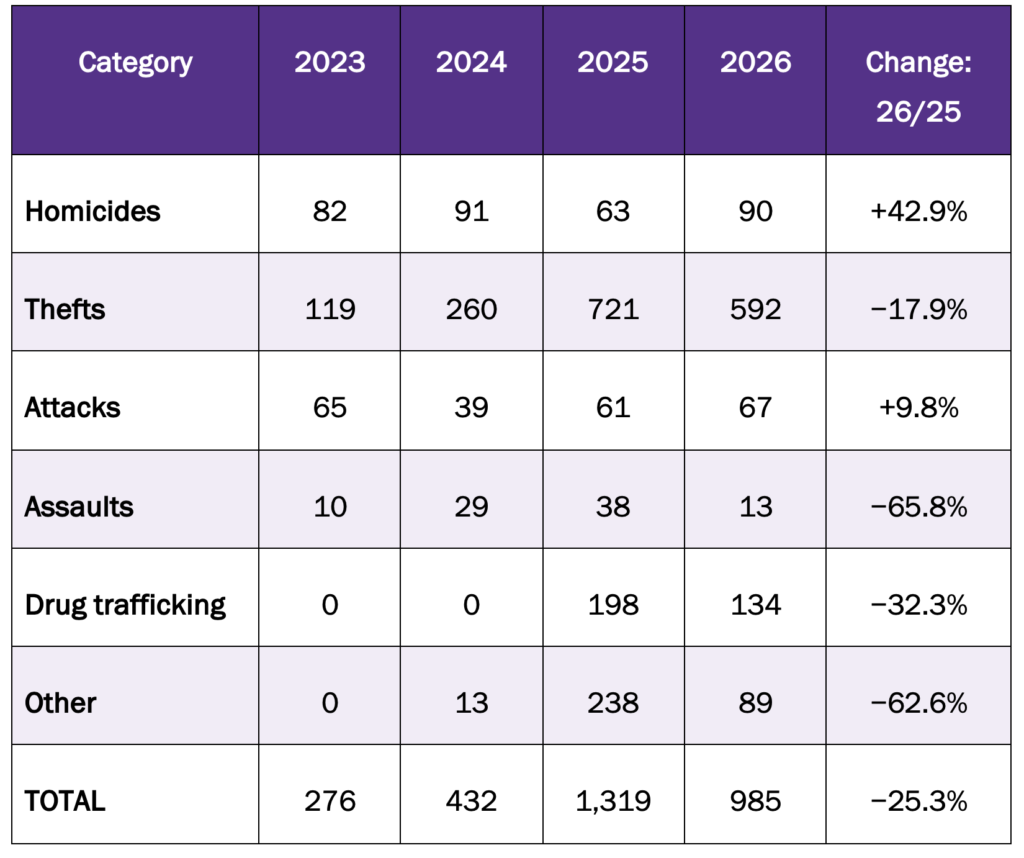
Table. Reported Crimes by Type. First halves of 2023, 2024, 2025, and 2026.
The Fatality Rate Nearly Doubles
The magnitude of the change is most clearly seen in the fatality rate, which relates the number of deaths to the total number of documented crimes.
During the first half of 2025, there were 5.23 deaths per 100 reported crimes. In the second half of the year, the figure rose to 6.61. For January–June 2026, it reached 10.35 deaths per 100 crimes.
In just one year, therefore, the fatality rate associated with documented crime increased by 97.9 percent—it nearly doubled.
This deterioration has a particularly severe impact on some of the most vulnerable groups. The number of women killed rose from 24 in 2025 to 37 in 2026, an increase of 54.2%. The number of elderly victims rose from six to nine, a 50% increase. But the most pronounced change occurred among minors: from three fatalities to eight, an increase of 166.7%.
Added to this is the rise in femicides. The Alas Tensas Gender Observatory (OGAT) documented 16 femicides during the first half of 2025. In the same period of 2026, it recorded 37—more than double. Within the year itself, an acceleration is also observed: 13 occurred during the first quarter and 24 during the second.
Theft remains the most common type of crime, but the nature of what is stolen is changing
Thefts continue to be the leading category of crime. They fell from 721 in the first half of 2025 to 592 in 2026, a decrease of 17.9%. However, they remain well above the levels recorded before the 2025 crime surge: the current figure is 127.7% higher than in 2024 and 397.5% higher than in 2023.
The nature of these crimes is also changing.
In 2025, 193 thefts involving livestock, 266 against private property, and 140 against state property were documented. In 2026, the first two categories decreased—149 involving livestock and 234 involving private property—while thefts targeting state property rose to 158, an increase of 12.9%. Their share of the identified targets rose from 19.4% to 26.7%.
One manifestation of this phenomenon is the looting of electrical infrastructure, particularly the theft of dielectric oil from transformers.
According to figures from the Prosecutor’s Office cited in the report, between 2025 and the first half of 2026, more than 460 criminal investigations were opened related to crimes against the national power grid, of which more than 300 specifically involved the theft of dielectric oil. The dossier documents cases in which the perpetrators themselves were electrocuted.
Matanzas and Granma Emerge on the New Crime Map
Another significant shift is geographic.
In 2025, Havana led the country in murders, with 14, and robberies, with 19. It also accounted for 109 of the 198 drug-related cases—more than half of all those documented nationwide.
In 2026, Matanzas ranked first nationally in murders for the first time, with 18, followed by Santiago de Cuba with 13 and Havana with 12. Matanzas also led in robberies, with 21.
In terms of thefts, Matanzas had already ranked first in 2025 with 143 cases. In 2026, that number rises to 155, even though this category decreases significantly nationwide. Granma, for its part, emerges with 146 robberies, and together these two provinces account for 301 of the 592 cases recorded nationwide: 50.8 percent.
The drug landscape is also changing. Reports dropped from 198 to 134, but the center of gravity has shifted eastward: Holguín leads with 33 cases and Granma recorded 27, while Havana fell from 109 to 19. The report notes, however, that this reduction in the capital may reflect either a real change or a decrease in the availability of public information on its commercialization and regarding police operations.
Among the cases in which the substance involved could be identified, so-called “chemicals” or synthetic cannabinoids accounted for 45.8 percent, followed by marijuana at 40.8 percent. Together, they accounted for 86.6 percent.
More Crimes Committed in Groups and Citizens Stepping in for the Police to Make Arrests
The new report also identifies an increase in group activity. Of the 2,026 crimes for which the modus operandi could be determined, 278 were committed by two or more people, equivalent to 33.7%. Among robberies, the proportion of group incidents reaches 37.7%, the highest figure recorded to date by the OCAC for that category.
Assaults show another worrying trend. Although their absolute number is relatively small, they rose from 61 to 67 -an increase of 9.8%—precisely during a six-month period in which the total number of reports decreased. Compared to 2024, the increase reaches 71.8%.
Finally, the report documents incidents in which citizens themselves have pursued or detained suspected criminals in response to what they describe as a lack of police response. In one of the cases cited, there were more than twenty previous reports; in another, a family claimed to have waited more than ten hours for the police to arrive and inspect a burglarized home. The OCAC warns of the risk that these dynamics may eventually lead to forms of vigilante justice.
The Trend in 2026: Rise in Crimes Involving Lethal Violence
A comparison of the two semesters reveals two distinct phases. 2025 was marked by a sharp increase in the number of documented crimes and greater diversity in criminal activity. In 2026, the number of independent news sources decreased, and with it, the visibility of the number of incidents reported; nevertheless, indicators of the most serious crimes increased.
The data summarize the shift: 25.3% fewer reports received, but 42.9% more murders; 47.8% more deaths; 9.8% more assaults; 54.2 % more women killed; 166.7% more minors killed; and a fatality rate that has nearly doubled in one year. Therefore, the decrease in the raw number of reports cannot be interpreted as an equivalent reduction in insecurity.
The most significant finding of this report: the criminal activity in Cuba that our independent sources were able to document in the first half of 2026—despite continuous and widespread power outages and internet service disruptions—shows a clear trend toward violence that is far more lethal than that observed a year earlier.