Descargar informe completo en Español
Download Report in English
Public Insecurity in Cuba Consolidates as a Structural Phenomenon
Summary of the 2025 Public Insecurity Report
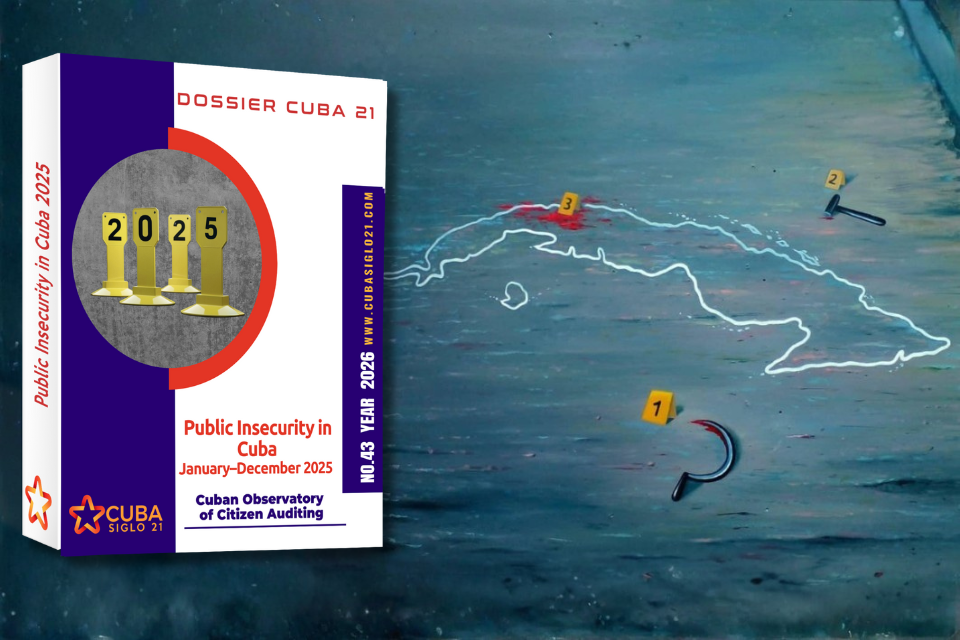
Throughout 2025, public insecurity in Cuba ceased to be a temporary or circumstantial issue and became consolidated as a structural, sustained, and expanding phenomenon. This is confirmed by the latest report from the Cuban Observatory of Citizen Auditing (OCAC), which systematically compiles, verifies, and analyzes reports of criminal incidents published on social media and in both state-run and independent media outlets between January and December of the year.
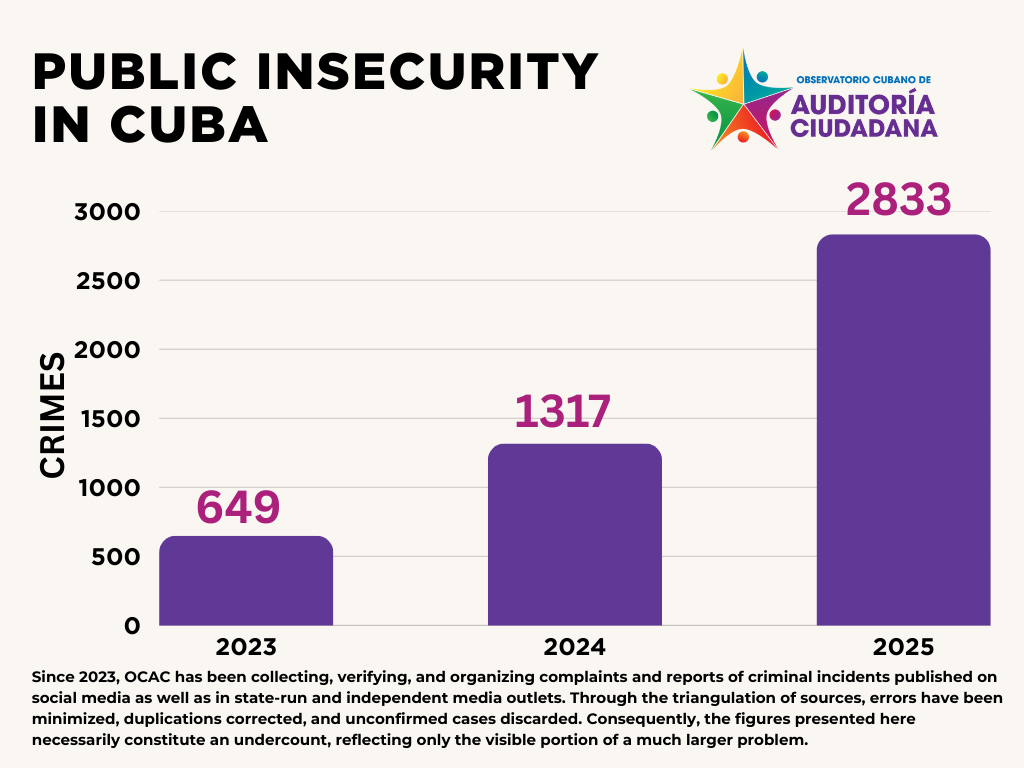
The study identified 2,833 reported crimes in 2025, representing a 115.11% increase compared to 2024 (1,317 reports) and a 336.58% increase compared to 2023 (649 reports). These figures, alarming in themselves, must be understood as a partial undercount, given the opacity of the Cuban state and the absence of comprehensive official crime statistics, which prevent an accurate measurement of the true magnitude of the problem.
Sustained and Widespread Growth
The expansion of criminal activity is neither concentrated in a specific period of the year nor explained by seasonal factors. In the second half of 2025 alone (July–December), 1,514 crimes were reported, equivalent to more than eight crimes per day. Monthly distribution data show consistently high levels throughout the period, reinforcing the conclusion that insecurity is driven by structural economic, social, institutional, and political causes, rather than isolated or episodic events.
The provinces with the highest number of reports over the year were Matanzas (503), Granma (424), Havana (398), and Santiago de Cuba (323). The shift of criminal activity toward central-eastern and eastern provinces constitutes one of the most significant territorial changes compared to previous years and points to an expansion of the crime map into regions marked by deeper material deprivation.
Crimes Against Property: The Core of Criminal Activity
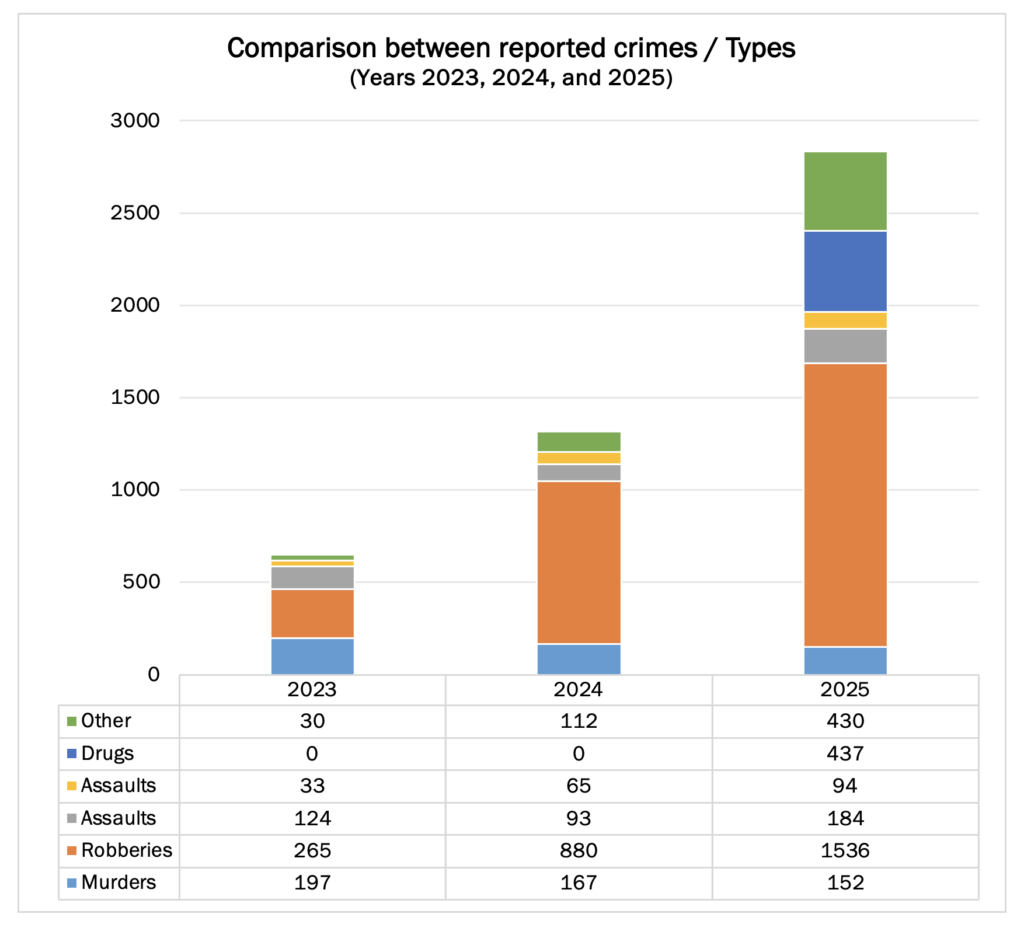
Robbery remained the dominant criminal category. In 2025, 1,536 robberies were reported, representing a 74.55% increase over 2024 and a 479.62% increase compared to 2023. This explosive growth makes crimes against property the most sensitive indicator of social deterioration and institutional breakdown.
Particularly significant is the fact that 407 robberies were linked to cattle theft and slaughter, a modality directly associated with food insecurity and the spread of illegal subsistence economies. In addition, 577 robberies targeted private property and 327 targeted state property, demonstrating that criminal activity affects both citizens and institutions in a transversal manner.
Drugs: A Qualitative Transformation of the Criminal Ecosystem
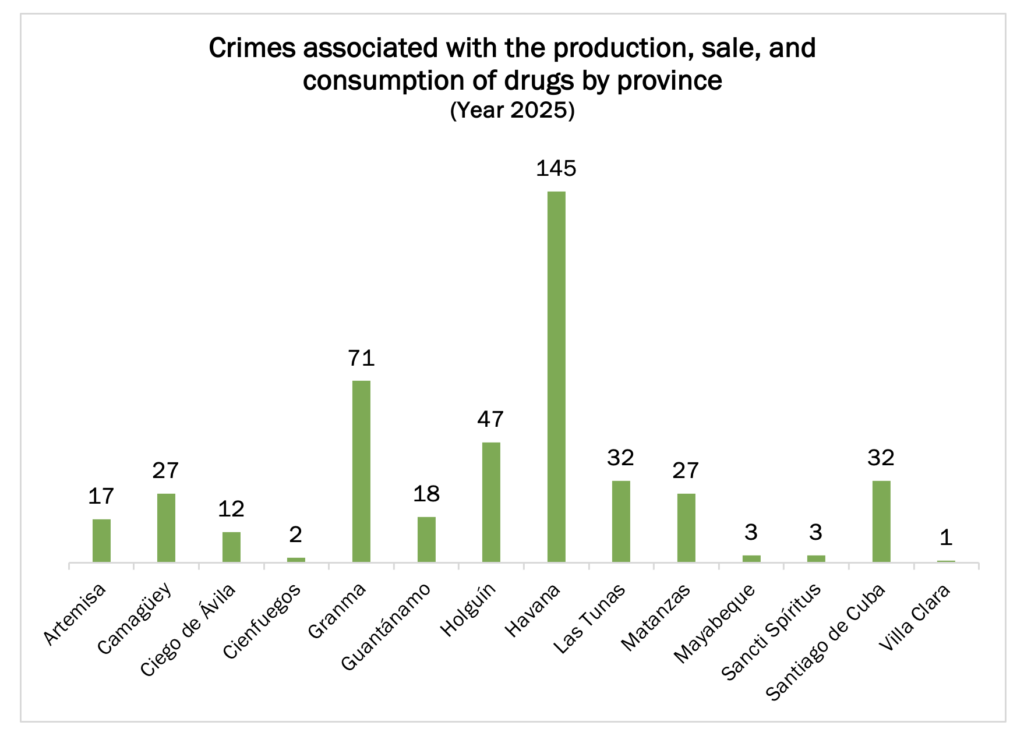
One of the most important findings of the report is the consolidation of crimes related to the production, sale, and consumption of drugs as a distinct and prominent category. In 2025, 437 such cases were reported—an unprecedented figure in OCAC’s monitoring series.
Havana led with 145 reports, followed by Granma (71) and Holguín (47), confirming both the capital’s continued centrality and the expansion of drug-related activity into eastern provinces. Synthetic cannabinoids (“chemical” or “paper”) and marijuana predominated—substances characterized by low cost, high availability, and strong penetration among young people.
The analysis also shows that most arrests occur at the individual level, suggesting that enforcement strategies focus on isolated detentions rather than dismantling trafficking networks, leaving underlying structures largely intact.
Interpersonal Violence and Crime Diversification
In 2025, 184 assaults and 94 aggravated assaults were reported, both categories showing substantial increases over previous years. Assaults rose by 97.85% compared to 2024, while aggravated assaults increased by 44.62% year-on-year and nearly tripled compared to 2023.
The category labeled “Other”, which includes vandalism, illegal possession of weapons, and related offenses, recorded 430 reports, marking a 283.93% increase over 2024 and a staggering 1,333% increase compared to 2023. This sharp rise reflects a rapid diversification of criminal behavior, a hallmark of deep institutional erosion.
Homicides: Relative Decline, Persistent Impact
In contrast to other crime categories, reported homicides declined slightly in 2025. A total of 152 murders were recorded, representing an 8.98% decrease from 2024 and a 22.84% decrease compared to 2023. Nevertheless, the social impact remains severe: 173 people died violently, including 48 women victims of femicide, as confirmed by the Alas Tensas Gender Observatory.
Havana, Santiago de Cuba, and Matanzas continued to be the main epicenters of lethal violence, suggesting the persistence of territorial dynamics linked to accumulated social conflict.
Perpetrators, Victims, and Social Degradation
Across the 2,833 reported crimes, 3,526 individuals were identified as perpetrators, over 87% of them men, confirming the pronounced gender imbalance in criminal authorship. The number of people involved exceeds that of 2024 by 1,894 individuals and that of 2023 by 2,581, indicating a steady expansion of the population directly engaged in criminal activity.
On the victim side, 700 victims were identified, including 213 women, 48 minors, and 62 elderly persons, highlighting the growing impact of criminal violence on particularly vulnerable groups.
Conclusions: Chronic Insecurity and Systemic Crisis
The data compiled in the report confirm that criminality in Cuba is not only increasing in volume, but also diversifying, spreading territorially, and becoming more socially damaging. Public insecurity is closely linked to the country’s systemic state collapse, marked by generalized impoverishment, the inability to guarantee basic services, and the erosion of non-political mechanisms of social control.
The absence of comprehensive official crime statistics, combined with the government’s propagandistic management of insecurity, obstructs effective public policy responses and further erodes public trust in institutions. In this context, criminality is not an anomaly but rather a direct expression of institutional and economic decay.
The year 2025 thus leaves a clear conclusion: unless the structural causes—economic, social, political, and institutional—are addressed, the trend will not be toward a reduction in crime, but toward the consolidation of chronic insecurity.